


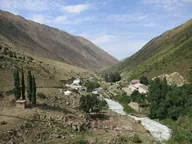
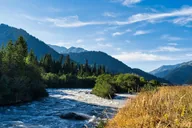
Winter Runs Out
Winter has a whole season. The lake has a summer’s worth of heat.
Watch the film · 40 sIllustration · not a temperature profile
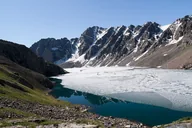
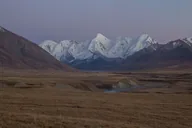
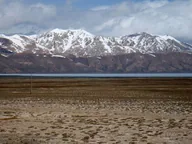
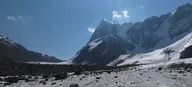
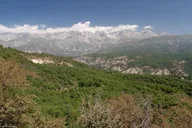
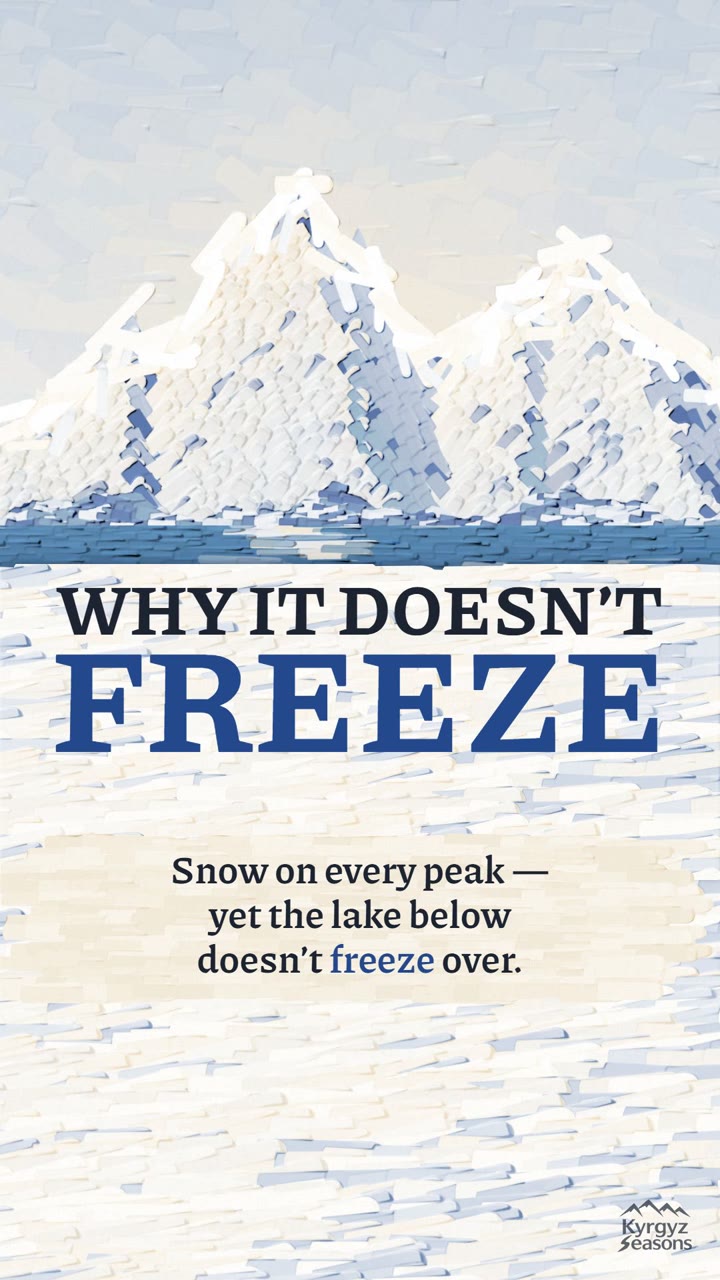
Snow on the peaks. Water underneath.
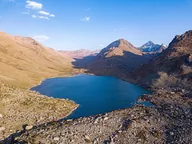
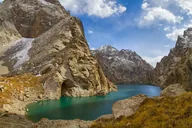
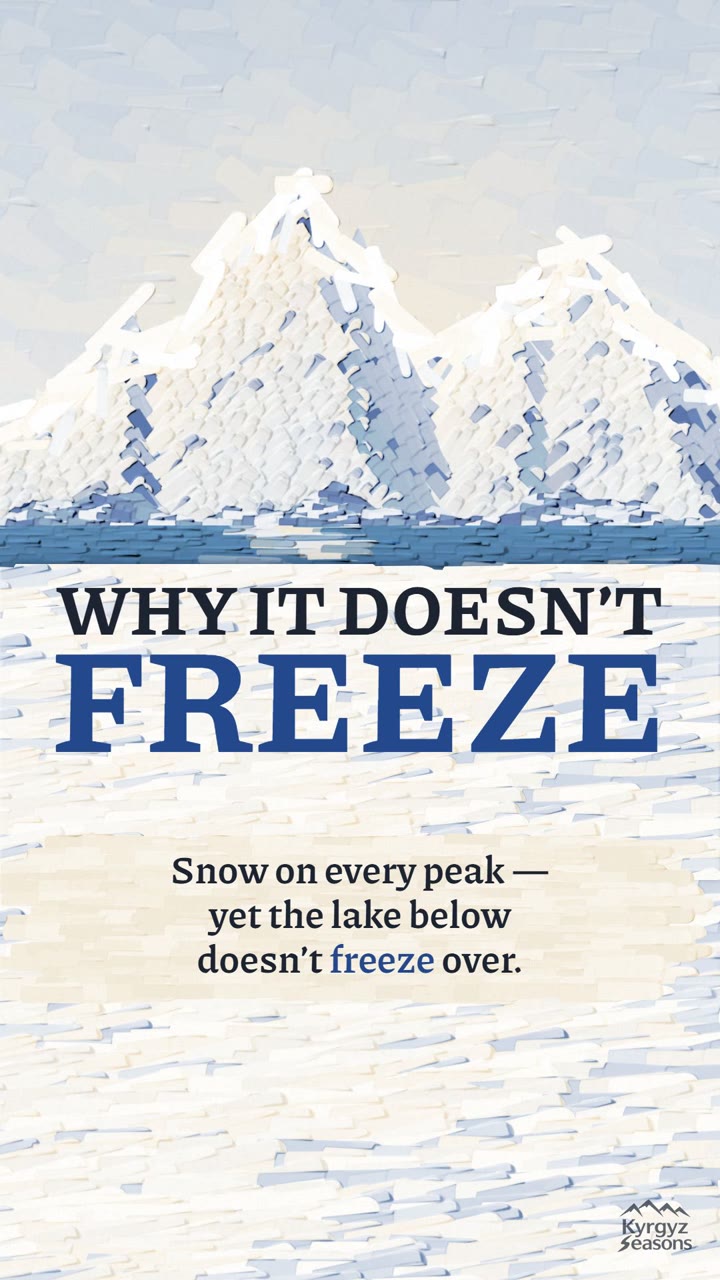
The mountain slopes are white; the lake is still blue. That is the contrast the film begins with. Its title gives winter a deadline: the cold season ends before this immense body of water loses enough heat to freeze over.
“Doesn’t freeze over” is the careful phrase. It leaves room for ice in shallow bays and beside the shore. It also leaves room for a visitor to find ice without having disproved the larger story.
Issyk-Kul’s Kyrgyz name means “hot lake”. Read that as a name, not an invitation to warm winter water. The scientific measurements tell a much colder and more interesting story.
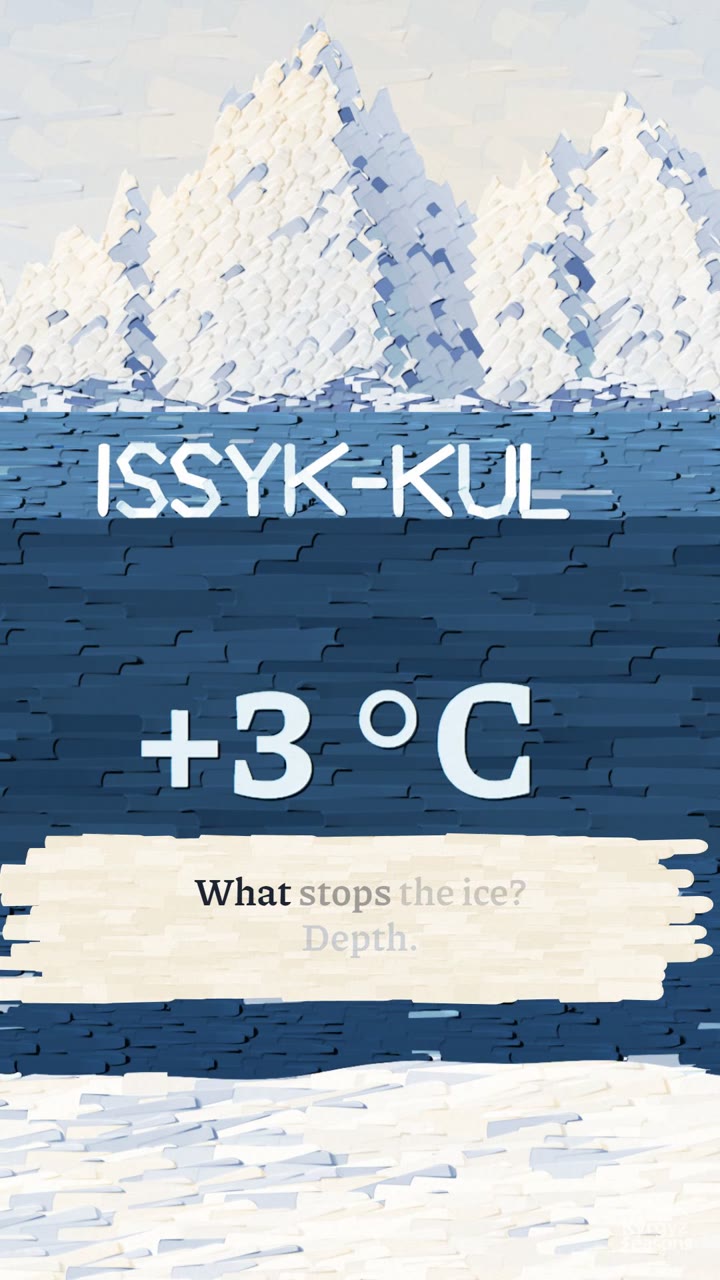
The depth changes the question.
The strongest echo-sounding figure cited by Zavialov and colleagues is 668 m. Their paper puts the lake’s volume at about 1,730 km³. This is a reservoir of heat, not a thin puddle exposed to a frosty night.
Salt matters, but “salty, so it cannot freeze” is too neat. The lake is only slightly saline. Its water density, stored heat and the way shallow and deep water cool and exchange all belong in the explanation.
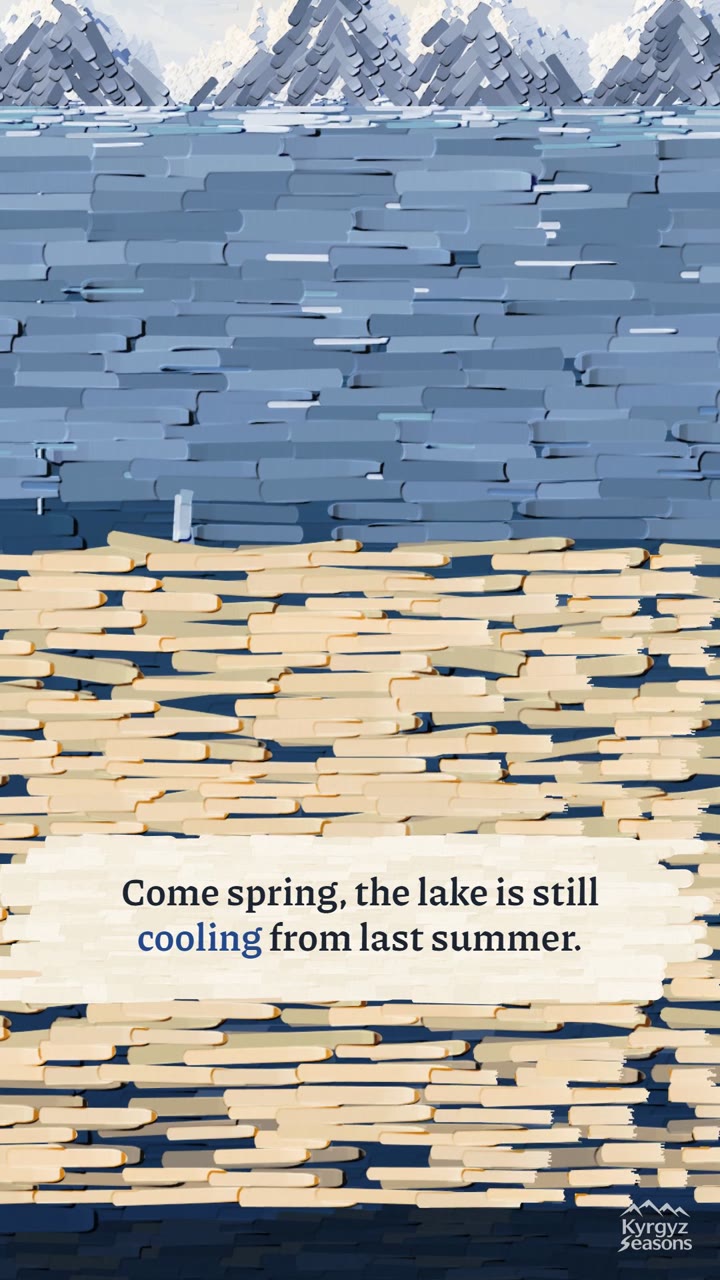
Our warm underpainting stands for that stored heat. Move the control: the cold paint advances, yet blue water remains. It is a visual metaphor. It does not calculate a freezing date, show a measured bottom profile or imply that every metre of the lake mixes evenly each winter.
Yes, this is ice on Issyk-Kul.
During the 2016–2017 cooling season, instruments on the eastern shelf recorded near-bottom February minima of 2.5–3.0°C. These were observations at particular moorings. They are not a single temperature for all the lake, nor a forecast for your visit.
In January 2023 a severe cold spell froze part of the northern edge. Sentinel-2 photographed floating ice on 15 January, off Kharkynbayevo and Chong-Oryuktyu. The photograph shows why the wording matters: shore ice and a completely frozen lake are different things.
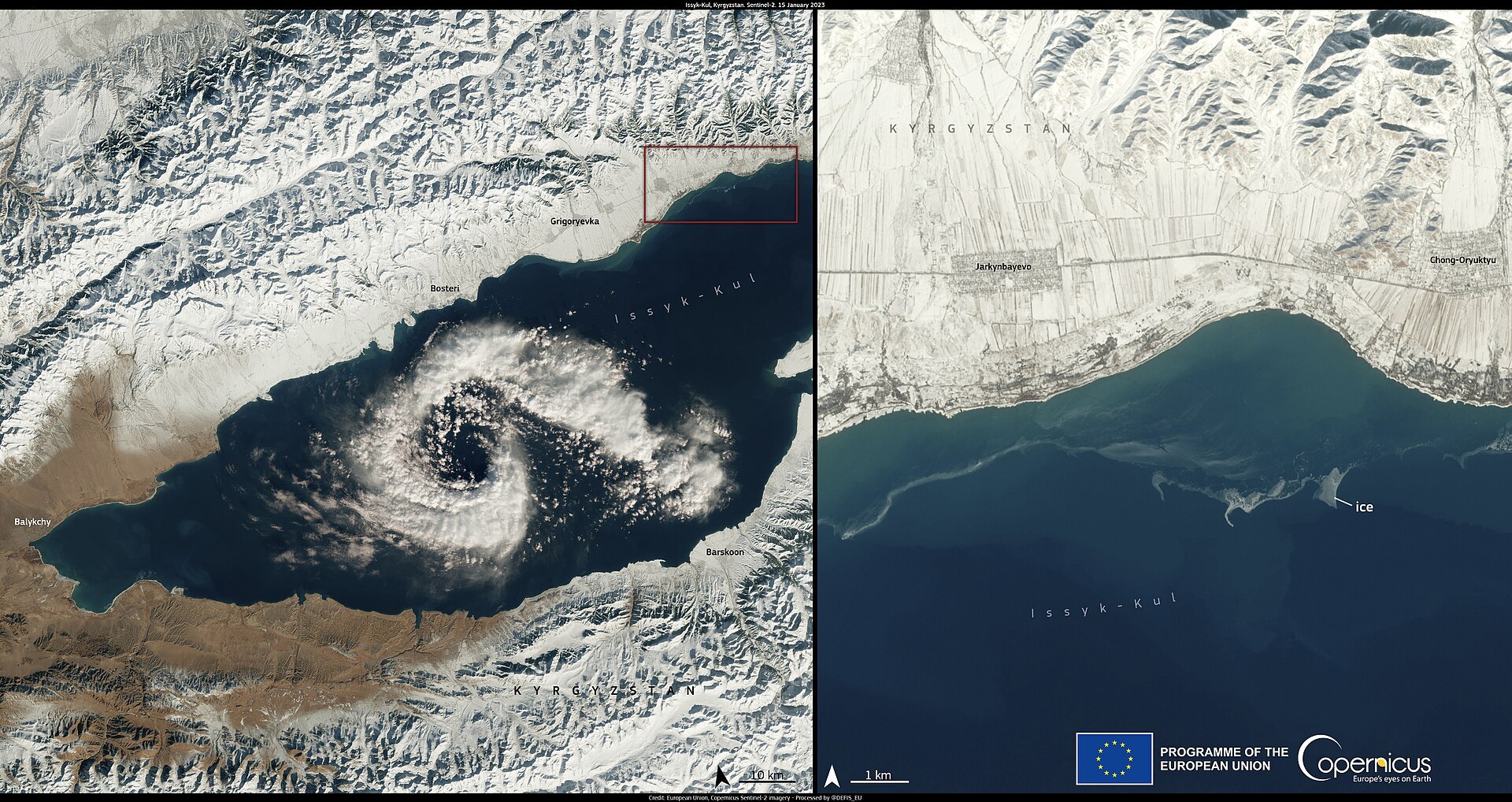
The film can strip a layer of paint away in an instant. Nature does not work to that cue. There is no ice calendar here, and no claim that a photograph from one cold spell describes every December.
From the shore, a wave. From orbit, a basin.
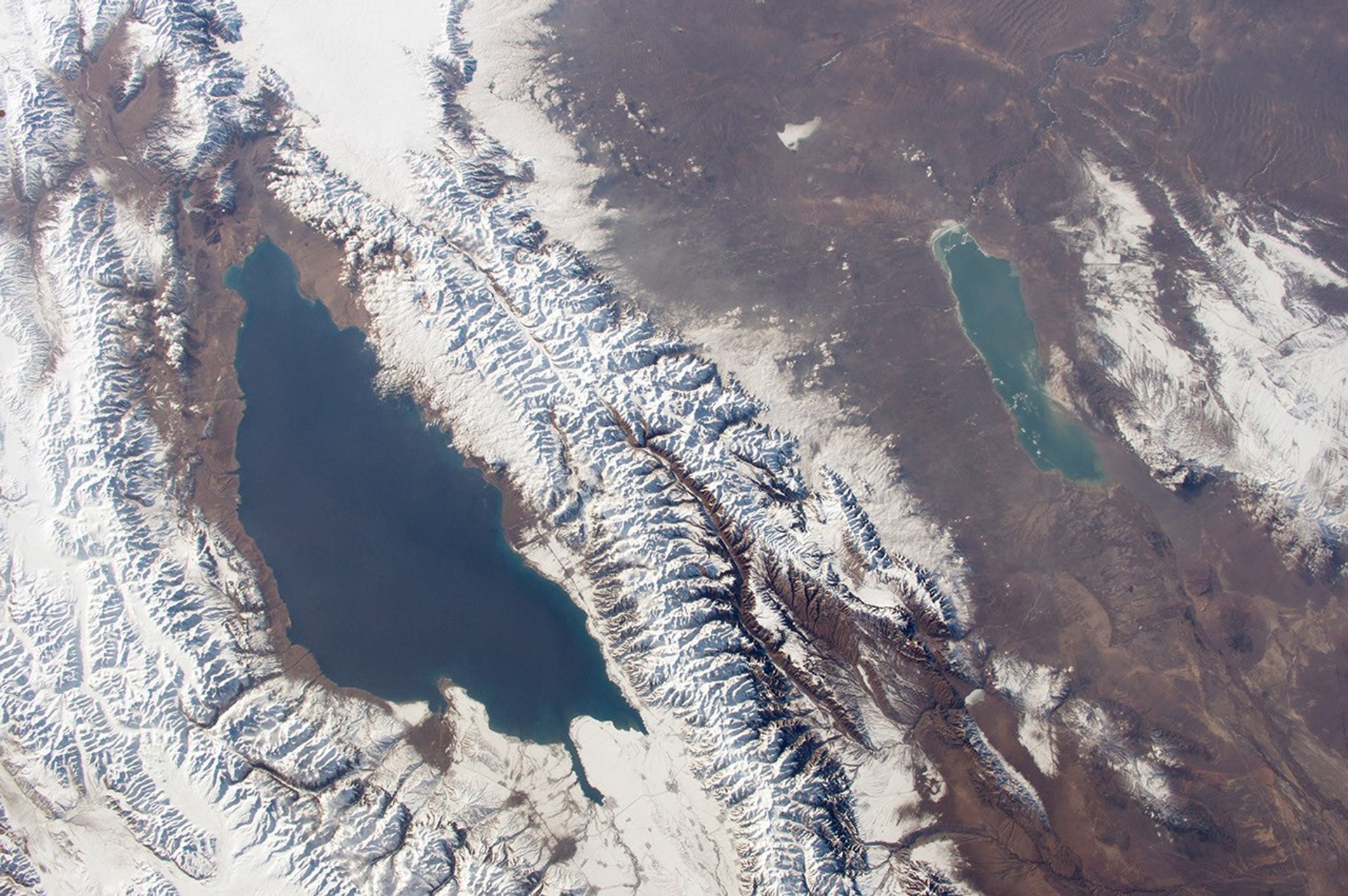
Step back to another winter. On 28 February 2015, an Expedition 42 astronaut photographed Issyk-Kul from the International Space Station. The dark lake sits inside the snowy Tian Shan. NASA’s published view also includes the lighter Kapchagay reservoir beyond the mountains.
These two satellite-era pictures answer different questions. One records ice at an edge in 2023. The other places the open lake within its winter mountain setting in 2015. They were not taken on the same day, and the painted transition does not turn them into a time-lapse.
The winter visitor is not always human.
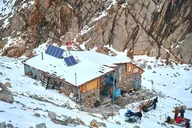
Ramsar identifies Issyk-Kul as an important wintering site for migratory waterbirds. Open water makes the winter scene more than a mountain panorama. The ducks in the film point towards that living landscape; they are illustrations, not a record of a particular flock.
Make a shore visit a chance to watch rather than a promise to collect a sighting. Use the lake guide to plan your approach, check local conditions before setting out, and give birds space. No bird count, shore-ice display or winter opening time is guaranteed on this page.
The scene is simple enough to keep: white mountains, dark water, a bird moving through the frame. Understanding the heat beneath it makes that quiet view stranger, not less beautiful.
Look past the first ice
A frozen edge and an open lake can belong to the same winter.
 Watch the 40-second filmThe film’s palette-knife paint becomes a moving lake. Scrape the blue layers to open real satellite photographs; the painted cross-section is an illustration, not a temperature model.
Want to see it for yourself?
Routes, places and the best months to go — everything for planning a trip to Kyrgyzstan.
Sources
- Peeters (2003) and Hofer (2002): see source 1.
- Zavialov (2018): see source 2.
- Copernicus (2023): see source 3.
- NASA (2015): see source 4.
- Ramsar site 1231: see source 5.
Pictures
- Film frames: Kyrgyz Seasons. Painted landscapes and the heat illustration are artistic interpretations.
- Orbit photograph: NASA/JSC, Expedition 42 crew, 28 February 2015. NASA informational media usage guidelines; US government work. Published image resized.
- Shore-ice image: European Union, Copernicus Sentinel-2 imagery, 15 January 2023. Copernicus Sentinel data, free reuse with attribution. Resized; no invented ice added.