
The Blood Is Light
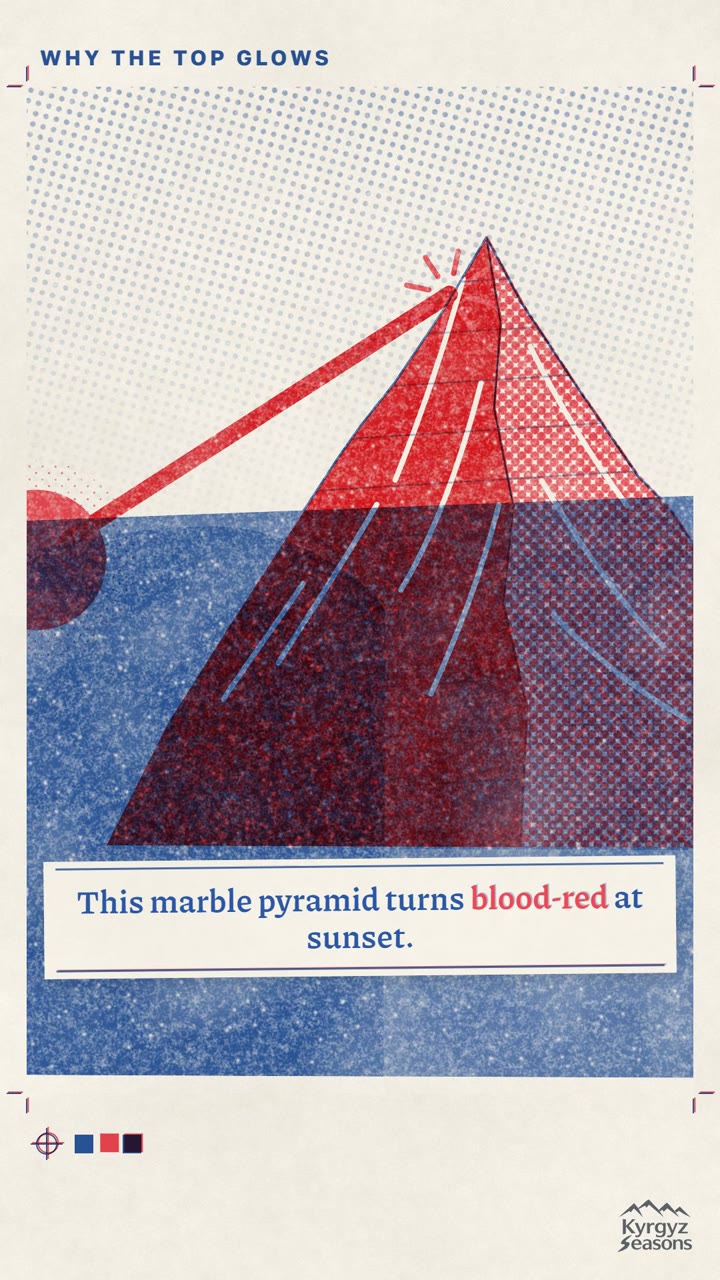
A pyramid of pale marble, nearly seven thousand metres high, turns blood-red on clear evenings. The colour is not in the stone. It is in the light.
Watch the film · 45 sA marble pyramid
“This marble pyramid turns blood-red at sunset.”From the film
Far in the east of Kyrgyzstan, past the end of every road, a nearly perfect pyramid of rock and ice rises over a river of ice. It stands on the Tengri-Tag ridge of the Central Tian Shan, above the South Inylchek glacier.
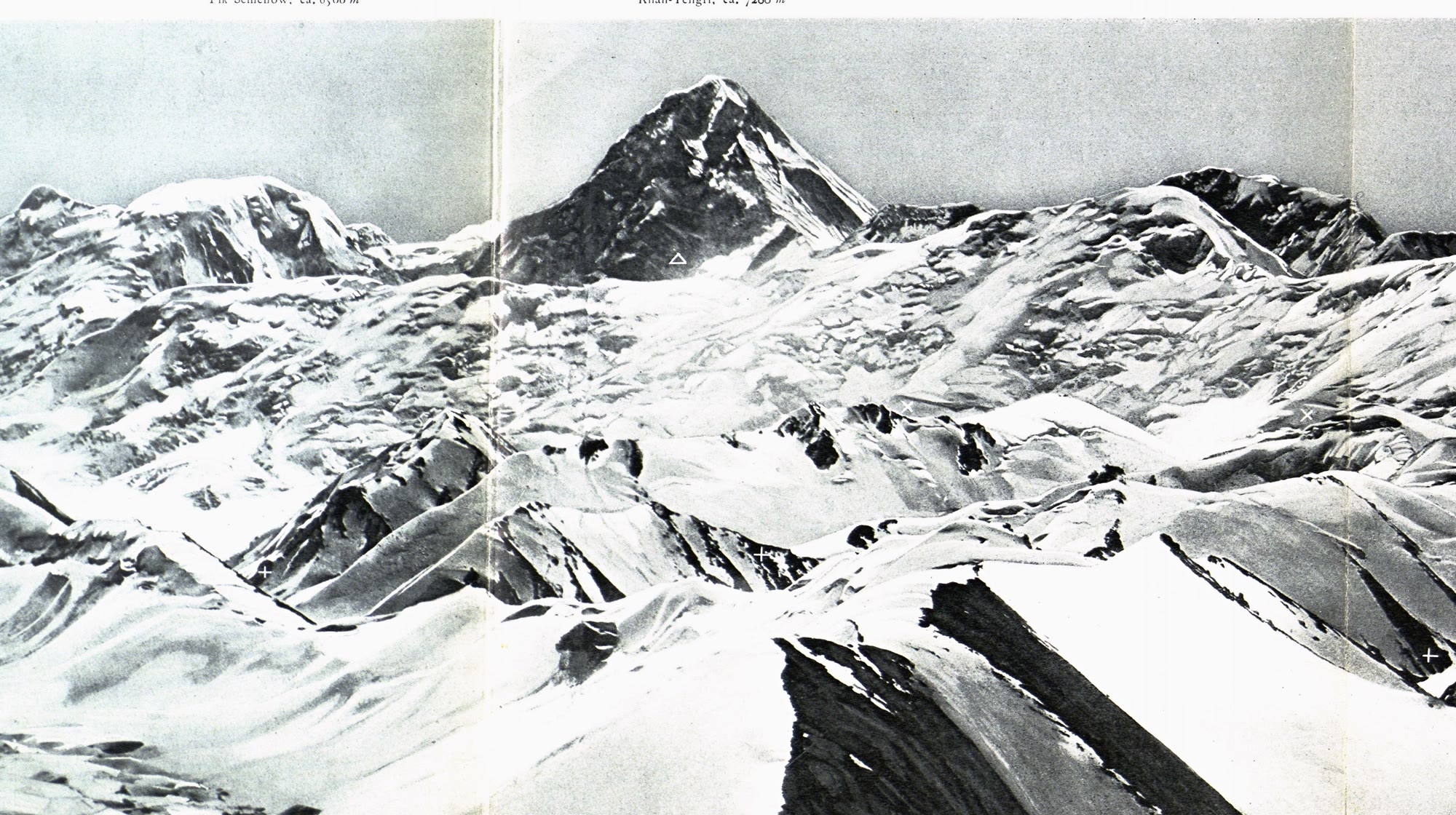
The first traveller to walk up the glacier to its foot was the German geographer Gottfried Merzbacher, in 1903. He looked at the mountain as a geologist and wrote down what it is made of: “The pyramidal cone of Khan-Tengri consists of more or less metamorphic limestones, and of stratified marbles.” Around its base he saw a dark band of other rock, a “black belt”, and above it the pyramid looked all the paler.
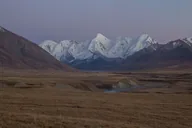
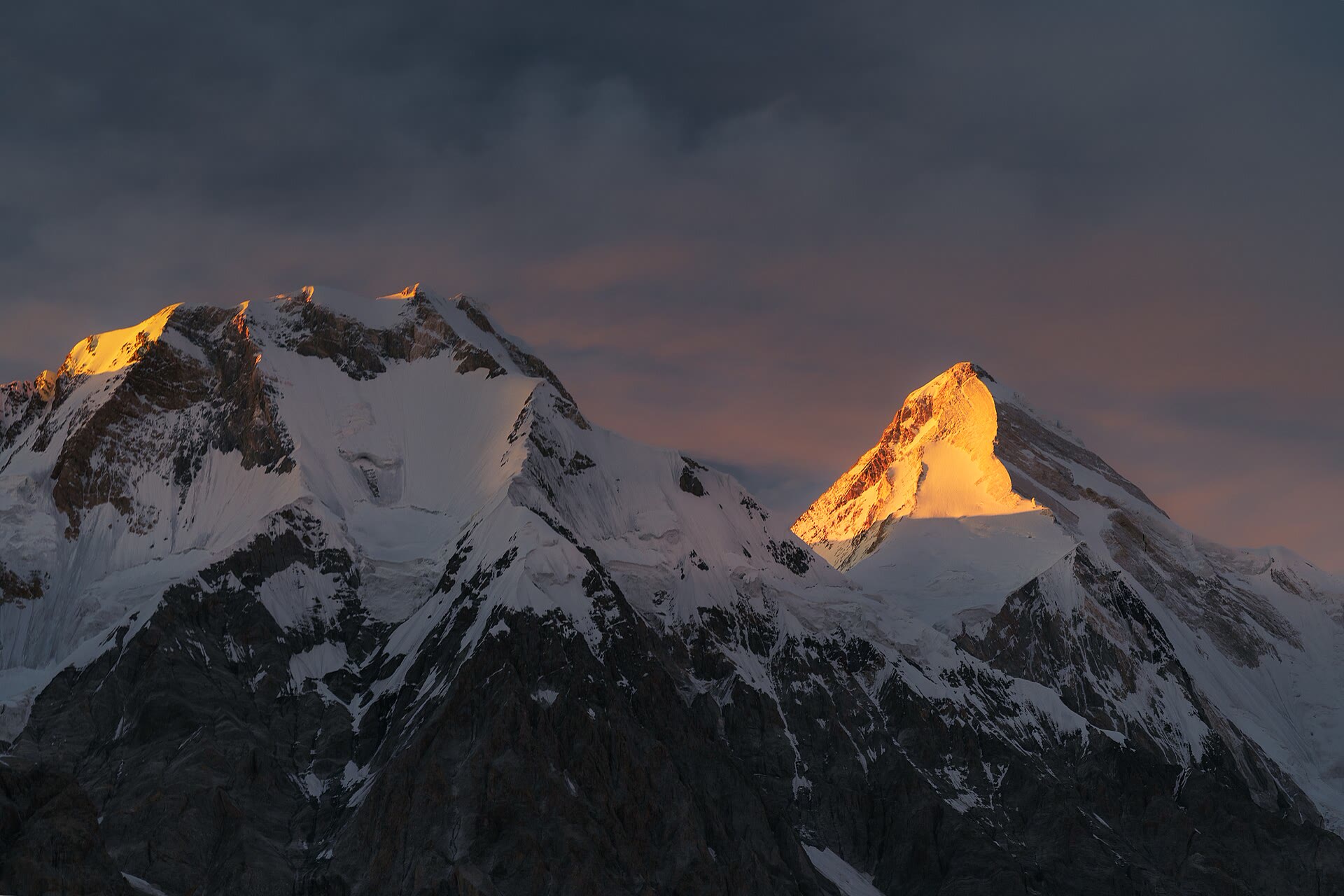
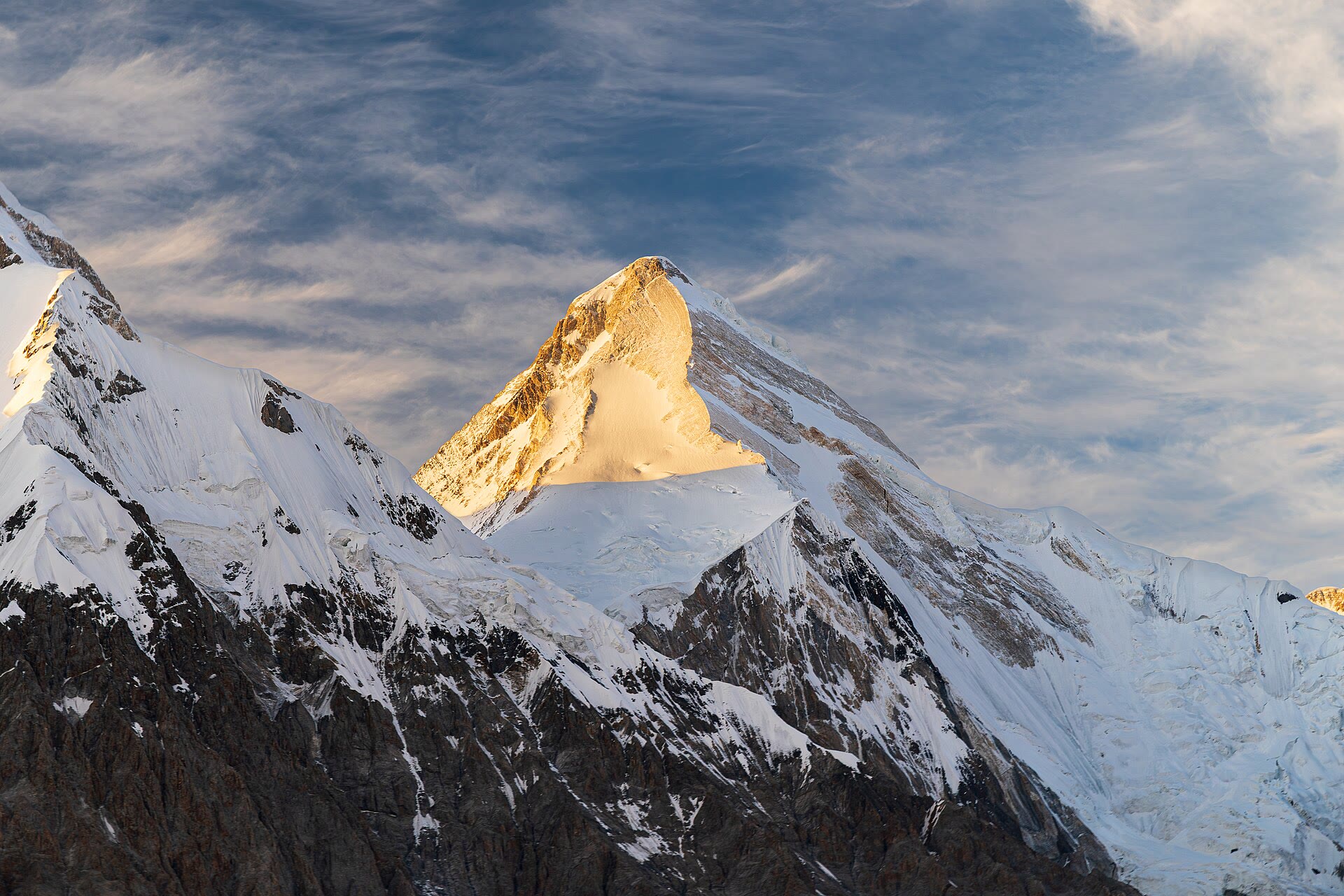
So the mountain is pale stone under snow. And yet on a clear evening, for a few minutes, its top burns red, as in the photograph below, taken from the base camp on the glacier.
Blood Mountain, Lord of the Sky
“Locals call it Kan-Too, Blood Mountain. Maps call it Khan Tengri.”From the film
In Kyrgyz kan is “blood” and too is “mountain”. Kan-Too is Blood Mountain.
The name on the maps is Turkic too. A khan is a ruler. The word tengri first meant “sky”, and Tengri was the sky god of the old faith of the steppe. So Khan Tengri reads as “Lord of the Sky”. The first European to see the peak was the Russian geographer Peter Semenov, in 1857.
For almost a century the pyramid was thought to be the highest summit of the Tian Shan. Only in 1943 did surveyors show that its neighbour, Pobeda Peak, 16 km to the south, is higher, at 7,439 m.
The valley goes dark first
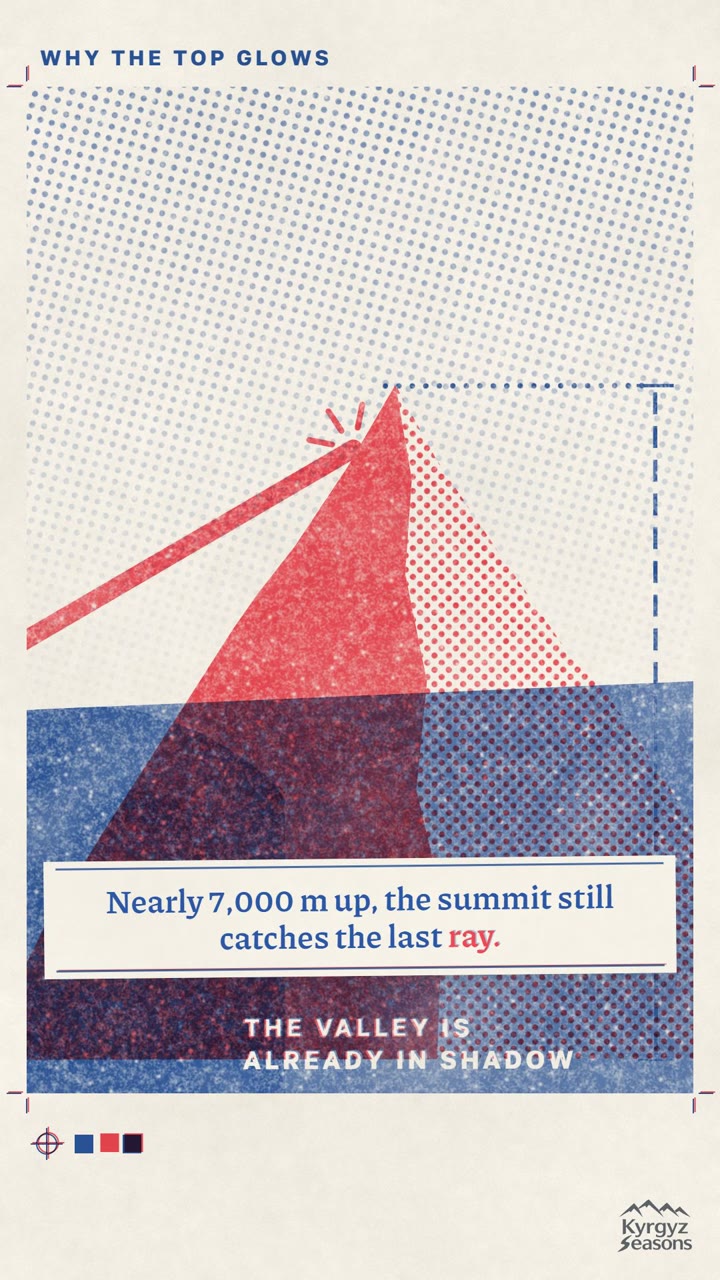
“As the sun sinks, the valley goes dark. Nearly seven thousand metres up, the summit still catches the last ray.”From the film
The red does not spread over the whole mountain. It comes in the order of height. First the glacier and the low ridges fall into blue shadow; the summit, far above them, still sees the sun.
Mountaineers call this alpenglow: at sunrise and sunset the highest peaks are lit while the valleys below are already in shade. On Khan Tengri the pink band starts at the tip and slides down the faces while everything around it turns grey and blue.
How high is it? Sources disagree by 15 metres, and the usual story, rock at 6,995 m and an ice cap on top, has no published survey behind it. So this page, like the film, says “nearly seven thousand”.
Only red reaches the top
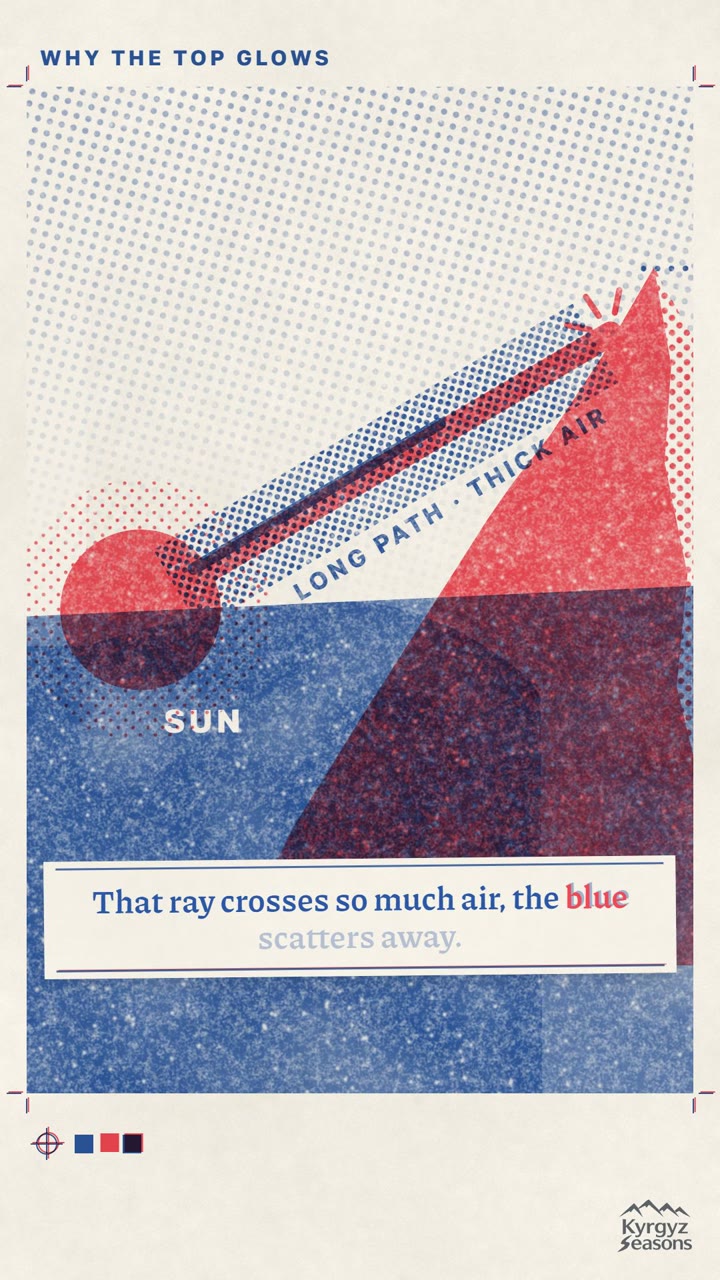
“That ray crosses so much air, the blue scatters away. Only red reaches the top.”From the film
Sunlight is white: a mix of all colours. On its way through the air it hits molecules, and they knock part of it aside. They do this much more to blue light than to red.
At noon the light crosses a thin layer of air on its way down. At sunset it comes in from the side, along the Earth, and crosses dozens of times more. Near the horizon the path is about 38 times as long as with the sun overhead. Over that long path almost all the blue is scattered out of the beam. What is left to arrive is orange and red.
Lower the sun
Drag the sun down. The sketch counts how much air its light crosses and mixes the colour that is left, for clean air only. Dust and haze make real sunsets redder still.
The stone is pale
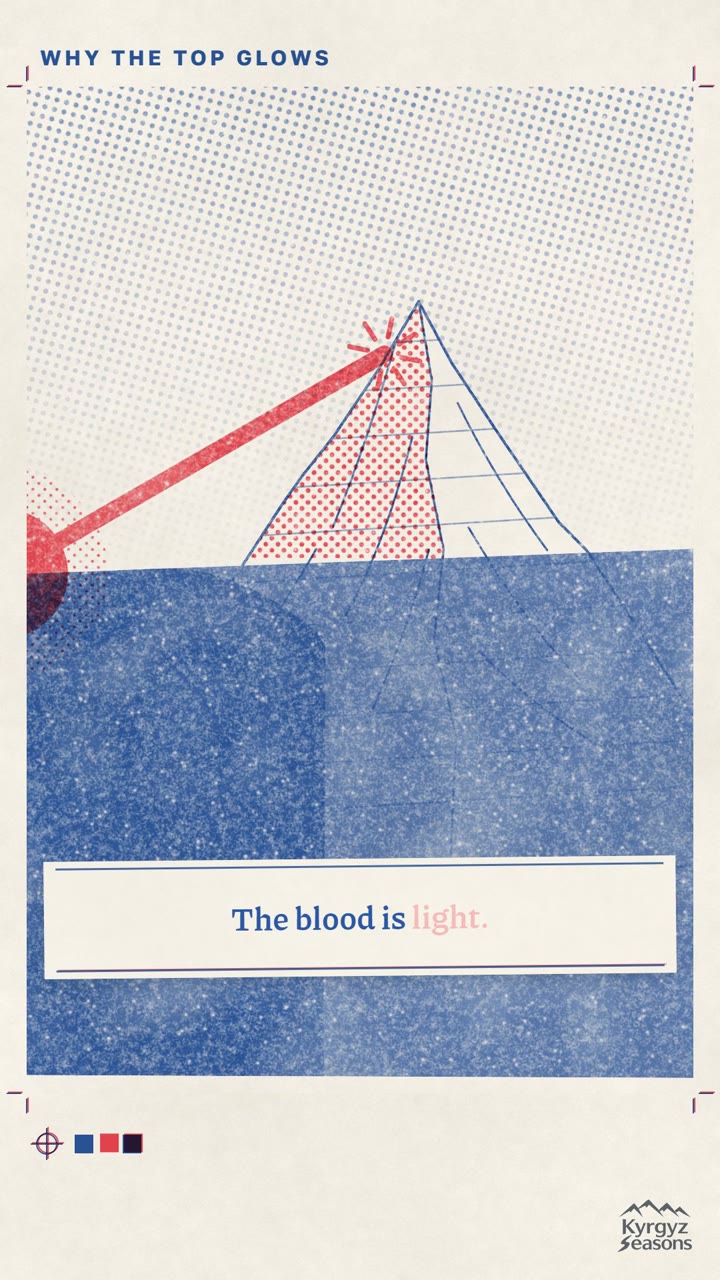
“The stone is pale. The blood is light.”From the film
Lift the red off the mountain, as the film does, and what is under it is bare and light: snow, ice and pale limestone.
Climbers who have touched it agree with Merzbacher. In 1964 a team led by Boris Romanov climbed the south-west ridge, known as the Marble Rib. Their report describes metamorphosed limestone “from light yellow to pink”, and adds that the Marble Rib turned out to be truly marble: white limestone polished by the wind. Only the tower just below the top is darker and softer. Half a century later another team on the south-east side wrote simply: “The rib was marble.”
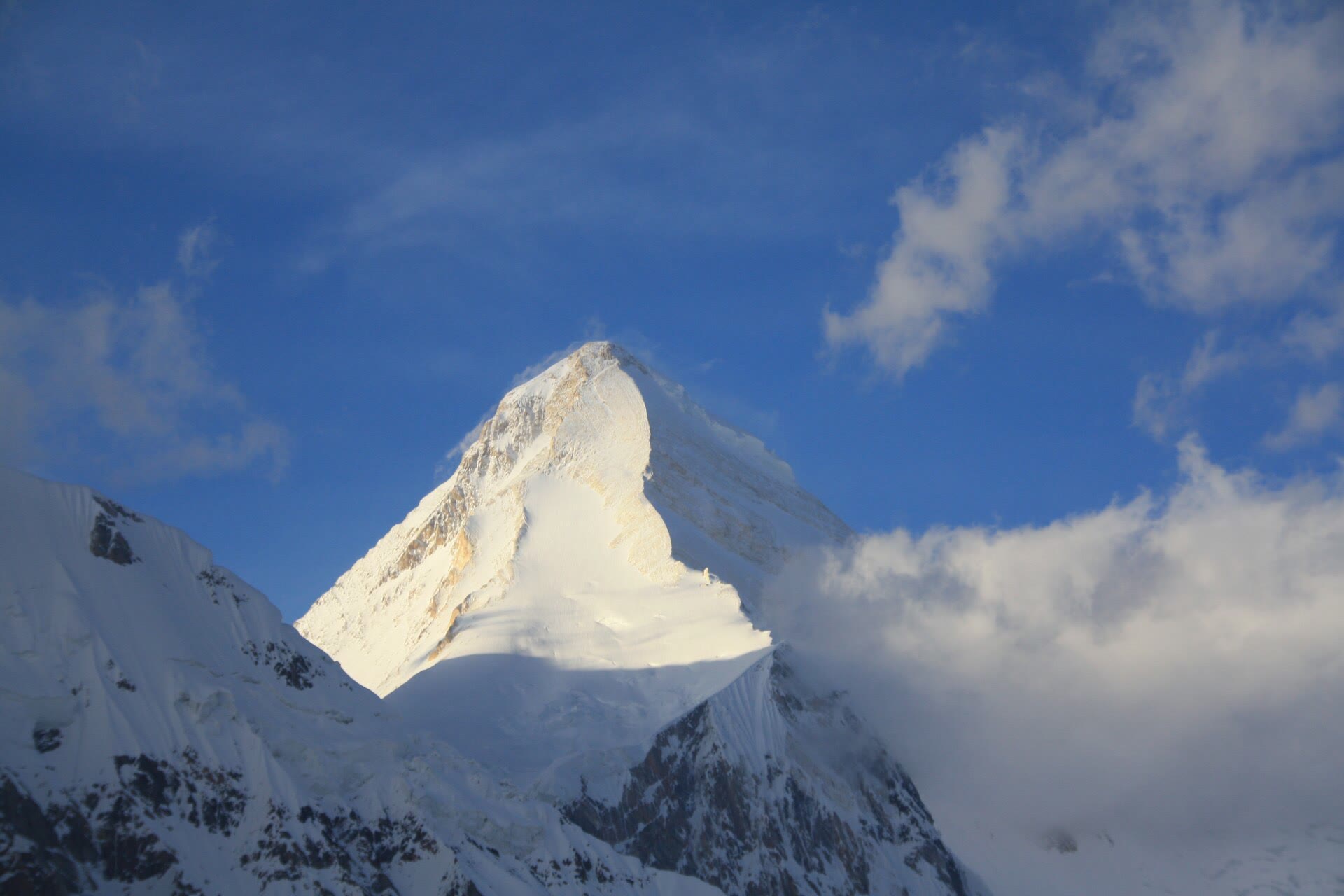
Some travel sites call the mountain pink granite. No geologist or climber says so; the rock is limestone and marble. And the stone does not glow by itself. A light surface simply shows well whatever light falls on it. At noon that light is white, so the mountain is white. At sunset only red is left, so the mountain is red.
The first to stand on the tip
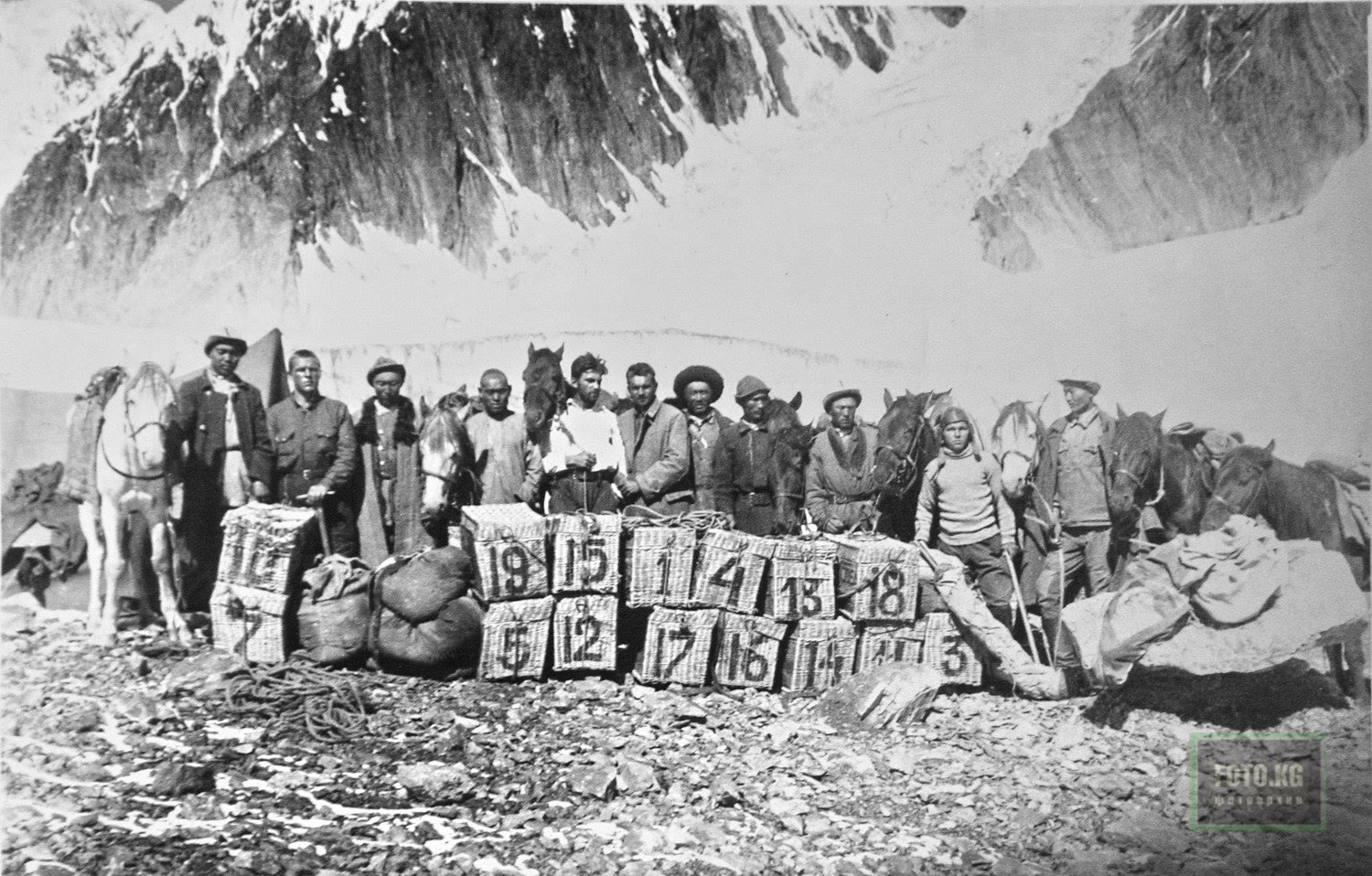
The first people to stand where the last light lands were three men of a Ukrainian expedition, on 11 September 1931: Mikhail Pogrebetsky from Kyiv, Boris Tyurin and Franz Sauberer from Kharkiv.
They came from the south, up the south-west slope and along the west ridge. Their line is still the classic way up, and the base camp where helicopters now land is on the same glacier. In 1964 two more routes followed: Romanov’s team on the Marble Rib, and the first ascent from the north by K. Kuzmin’s group.
Stand in the shadow
“In summer a helicopter lands you on the Inylchek glacier below it.”From the film
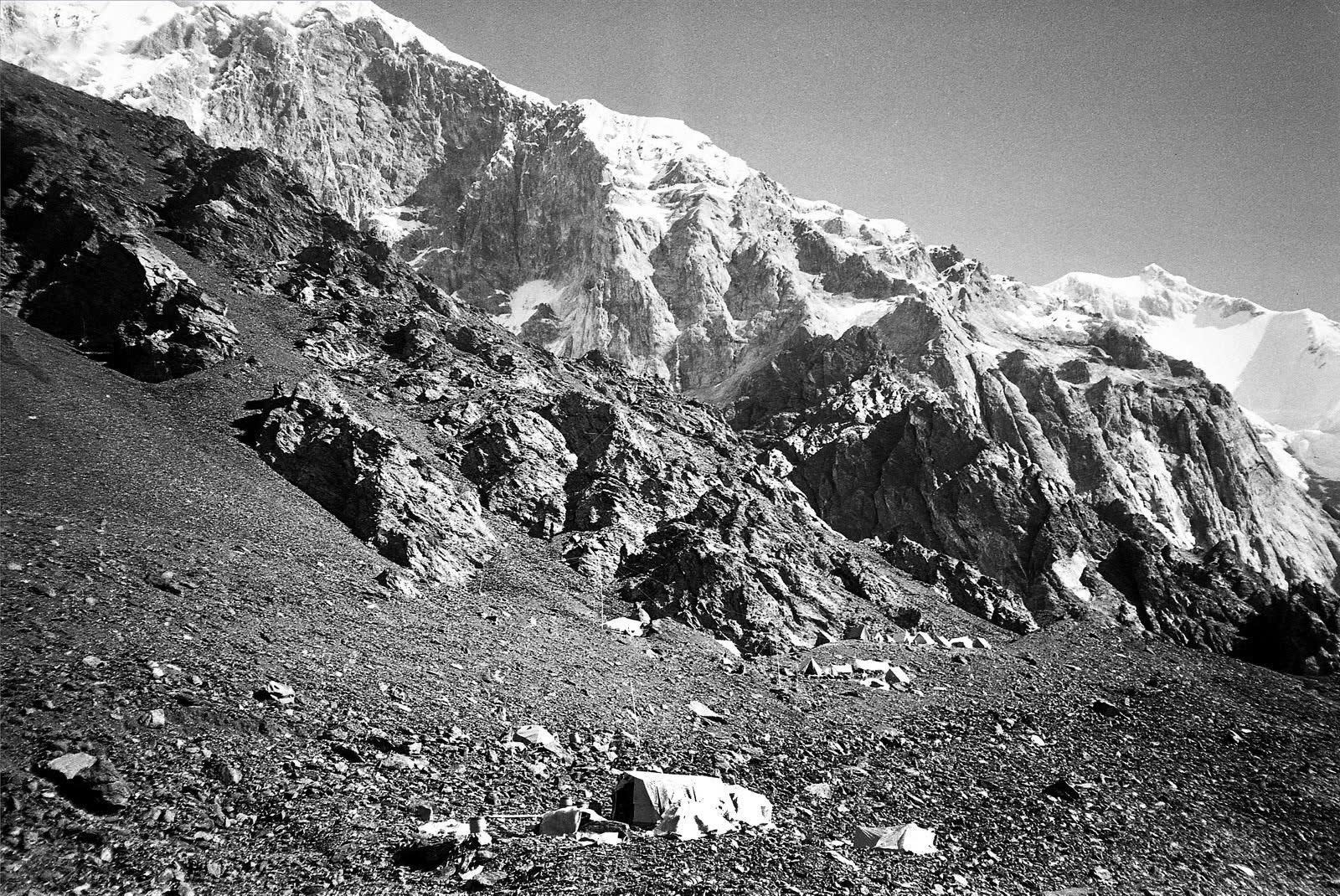
You cannot see Khan Tengri from a road or a town. The easy way to stand below it is a summer helicopter trip: from Karkyra camp in the east of the Issyk-Kul region a helicopter flies over the Inylchek glacier and Merzbacher Lake and lands at the base camp on the South Inylchek glacier, with Khan Tengri and Pobeda Peak in view. You sleep in tents on the ice and fly back the next morning. The area lies inside the Khan-Tengri Nature Park, created in 2016, home of the snow leopard.
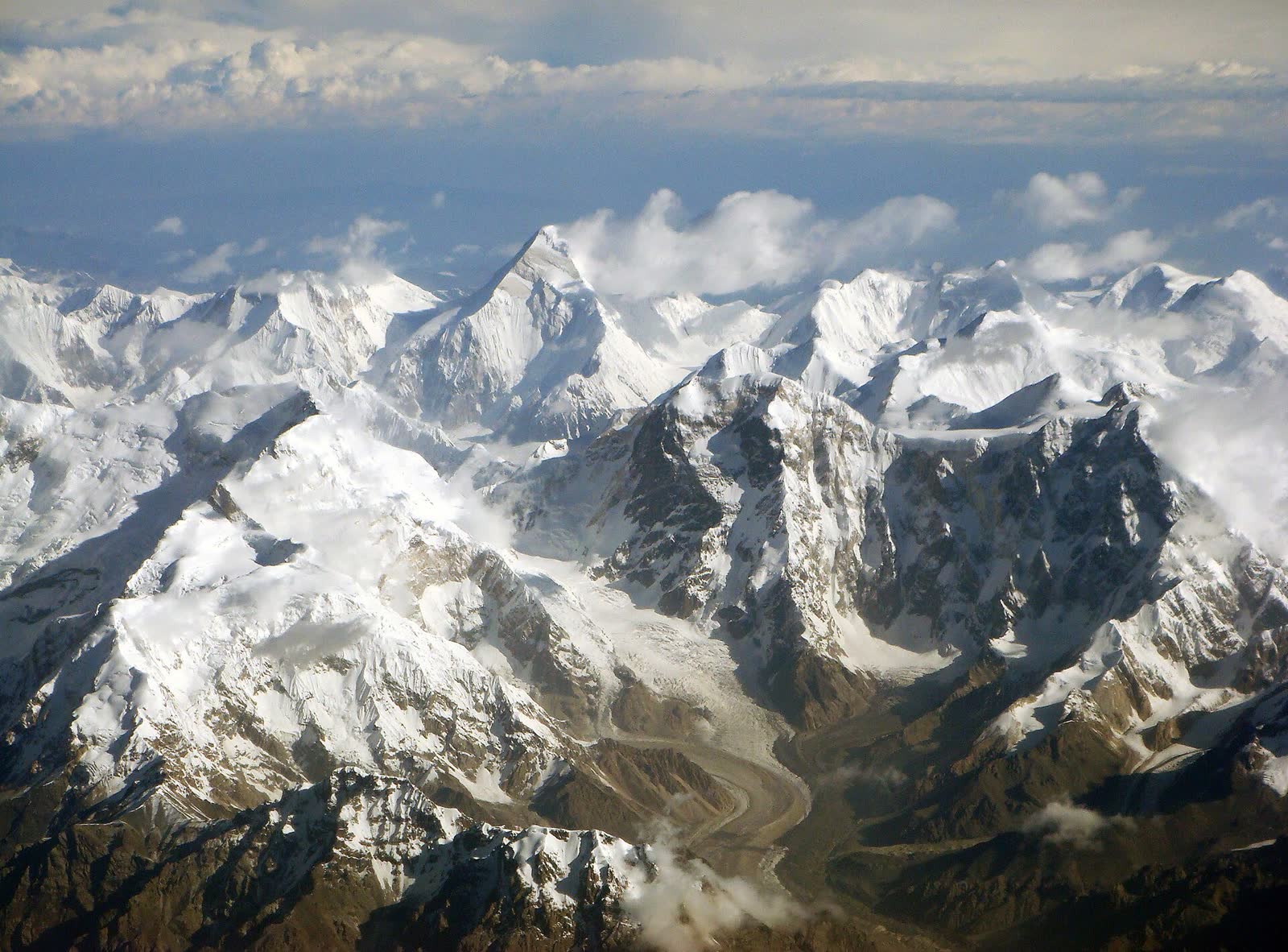
Blood Mountain earns its name
The stone stays pale. For a few minutes on a clear evening, the light is the blood.
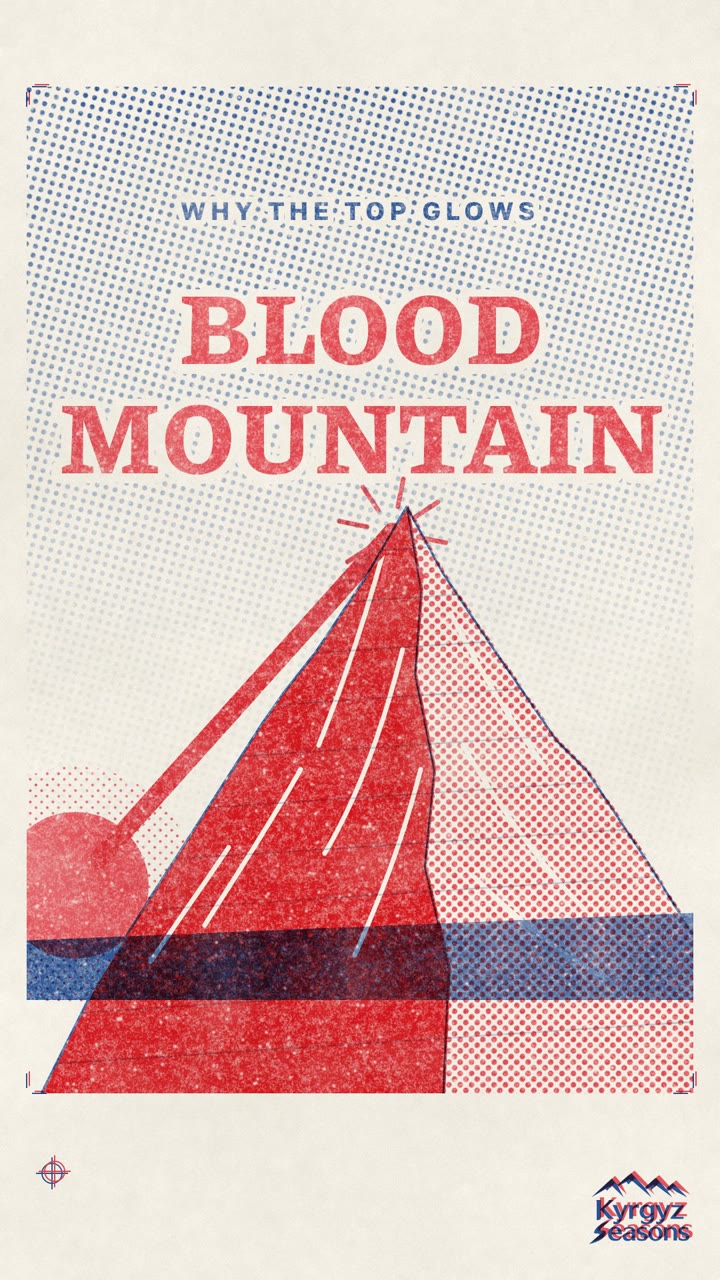 Watch the 45-second filmThe same story as a two-colour risograph print: blue for air and shadow, red for the last light.
Want to see it for yourself?
Routes, places and the best months to go — everything for planning a trip to Kyrgyzstan.
Sources
- G. Merzbacher, The Central Tian-Shan Mountains 1902–1903, London: John Murray, 1905. Full text
- B. Romanov et al., report on the ascent of Khan Tengri by the south-west ridge (Marble Rib), 1964. summitx.info
- A. Ivanov, V. Petlitsky, “Khan Tengri (6,995m), Southeast Ridge Integral”, American Alpine Journal, 2012. publications.americanalpineclub.org
- V. Shataev, list of ascents of Khan Tengri (6,995 m), Russian Mountaineering Federation, 2019. alpfederation.ru
- Wikipedia: Khan Tengri, Alpenglow, Rayleigh scattering, Air mass (astronomy), Khan-Tengiri Nature Park; Wiktionary: kan.
- L. Cowley, Atmospheric Optics, Everest alpenglow.
- Ak-Sai Travel, Helicopter tour to the South Inylchek base camp and South Engilchek base camp; tours.too.kg, Permit for Enilchek, Khan Tengri and Sary-Djaz.
- Kyrgyz Seasons, Inylchek Glacier: season, weather and how to get there.
Pictures
- Risograph scenes and film frames: the Kyrgyz Seasons film “The Blood Is Light”. The light sketch in chapter IV is a simple model drawn by code.
- Khan Tengri at sunset and in the golden hour, from the South Engilchek base camp, 1 August 2021: Maryliflower, CC BY-SA 4.0.
- Panorama of the Central Tian Shan from the north, Zeitschrift des Deutschen und Österreichischen Alpenvereins, 1906: Gottfried Merzbacher, public domain.
- Khan Tengri in daylight and the Central Tian Shan from the air: Chen Zhao, CC BY 2.0. Members of the 1931 expedition: unknown photographer, public domain. The South Inylchek camp, 1987: Jaan Künnap, CC BY-SA 4.0. All via Wikimedia Commons.