










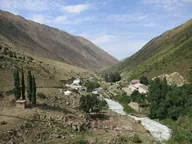

Polo, but the ball is a goat
The hook is a goat. The story is the skill it takes to carry it.
Watch the film · 55 sFirst, feel the weight.
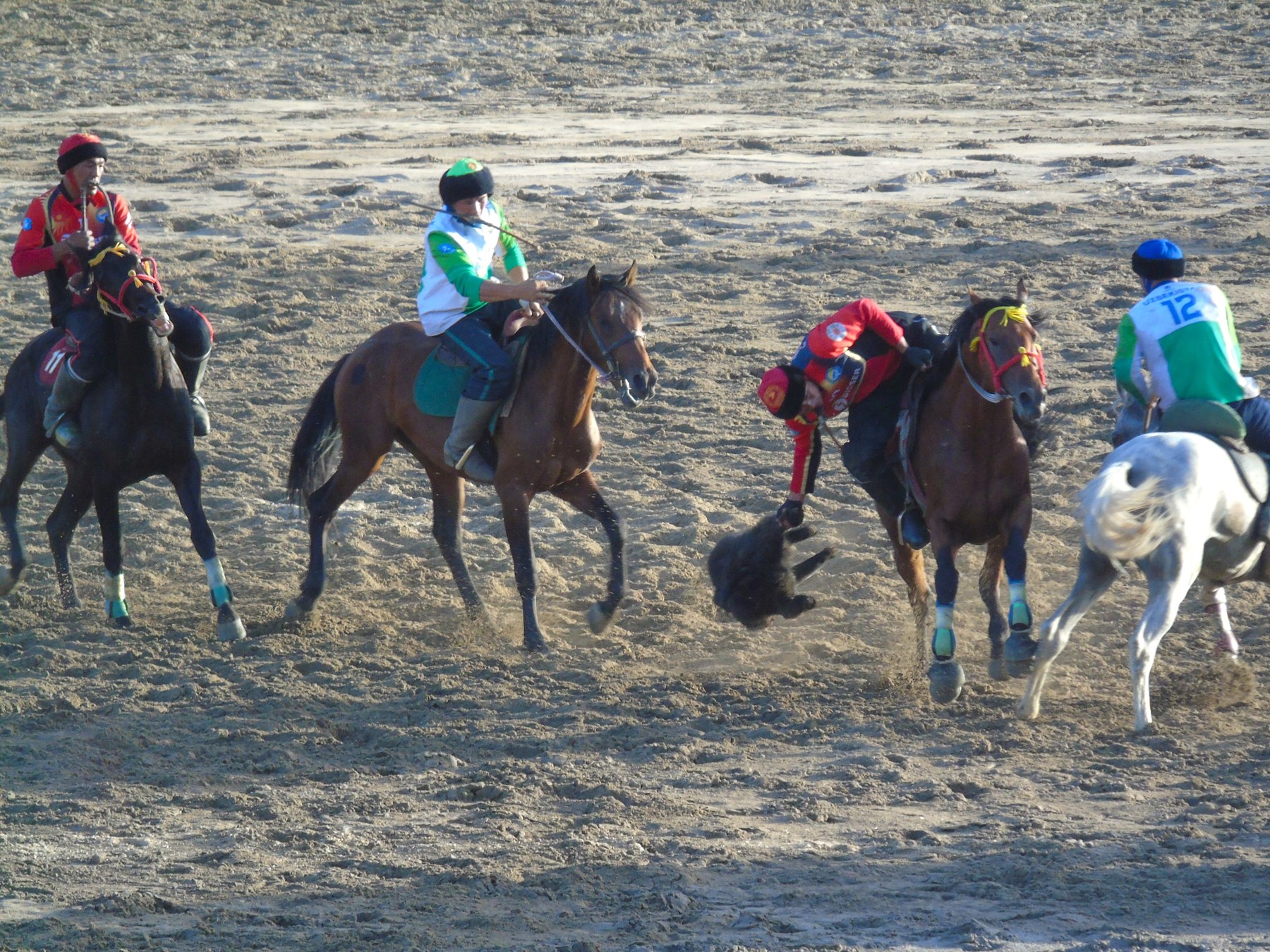
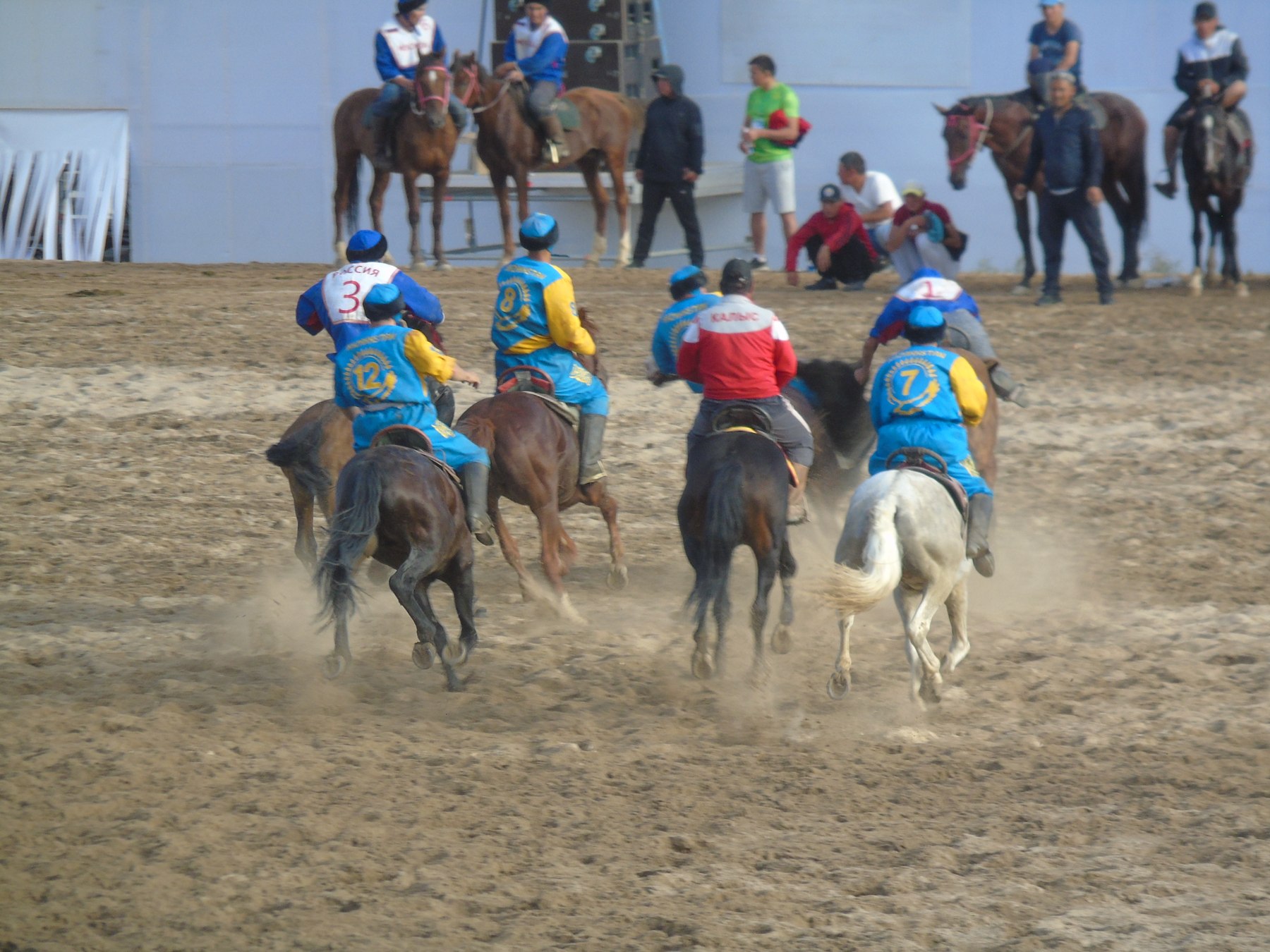
A rider is bent almost out of the saddle. Look below the horse’s shoulder: that is where the object of the game has to be lifted. The opening joke of our film is “polo”. The photograph asks you to look again.
The object is called an ulak. The Federation’s rulebook allows a goat carcass or a dummy. It specifies 30–32 kilograms for the carcass, with separate provisions for muddy ground and preparation; a dummy must weigh 30 kilograms. So “about thirty kilos” is a useful first impression, not one universal weight for every game.
Rulebook weight; exceptions apply to muddy ground and preparation.
Both belong in an honest account of the sport. UNESCO’s heritage description mentions a mould used in modern games, while the Federation’s own rules still provide for a carcass. A photograph of one match cannot settle what every organiser uses.

Eight riders.
One moving problem.
Four riders from each side are on the field at once. The squad is larger: the Federation describes a team of twelve, with competition provisions for rosters of eight to twelve and substitutions of riders and horses. Count the active players, not everyone waiting beside the field.
Possession is only the start. A rider must get the ulak off the ground, retain it against an opponent and take it to the other side’s goal. Watch the space around the carrier: the game is easier to follow once you have found that rider and the direction of attack.
Carry it.
Keep it. Throw it.
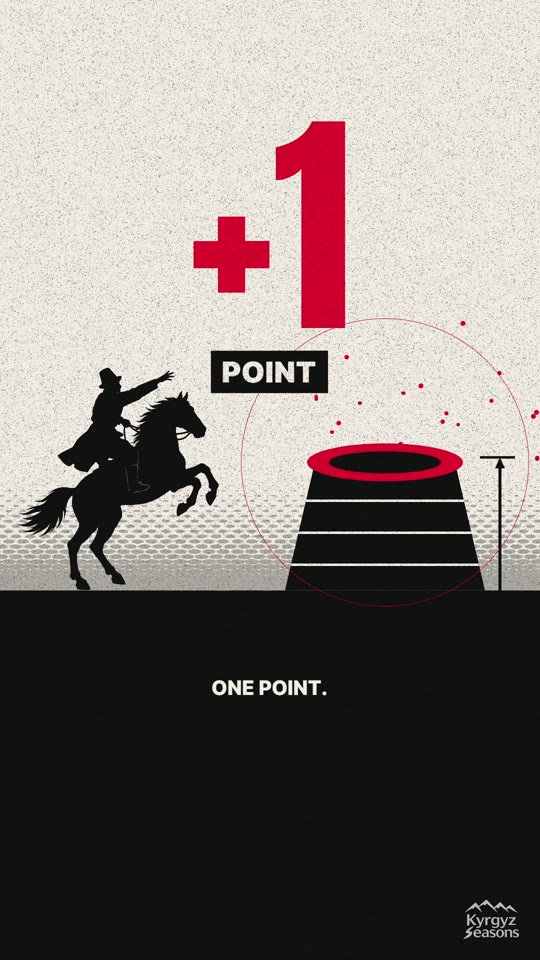
The destination is a tai-kazan, the raised goal at the opposing end. A successful throw into it scores. The referee’s whistle stops the action when the carcass enters a goal; the team with more points wins. In the film, this becomes a dotted arc and a very large “+1”. Here, try that last movement yourself.
The contact has limits. The rulebook allows nudging with a horse and torso-to-torso pushing; it forbids striking and riding into someone picking up the ulak. “Anything goes” would be the wrong caption for what looks, at first, like a scrum.

Then why a wolf?
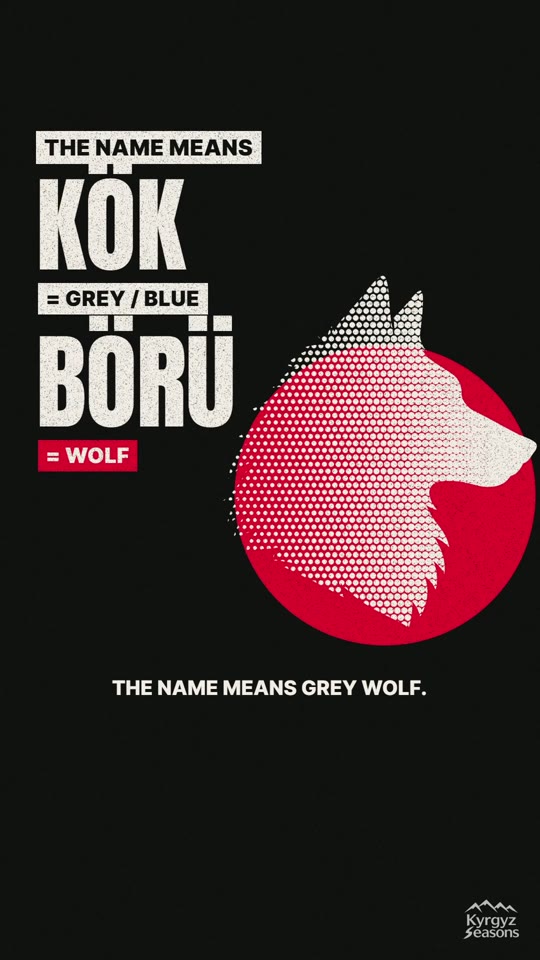
The UNESCO International Centre of Martial Arts translates kok boru as “grey wolf”. It suggests that informal contests among shepherds guarding their flocks are the likely origin. A wolf, a goat and a sporting contest sit together in the name, but a neat story is not the same thing as a documented beginning.
Grey wolf.
In the legend, mounted shepherds or hunters compete over a wolf killed while defending livestock. Anarbaev’s research treats it as a legend. It is not a dated record of the first match.
That distinction leaves the story interesting. It lets the wolf remain part of cultural memory without making it an eyewitness account. Research on pastoralists and predators in Alai records the legend and the wolf’s place in the sport’s imagery.
Heritage that moves.
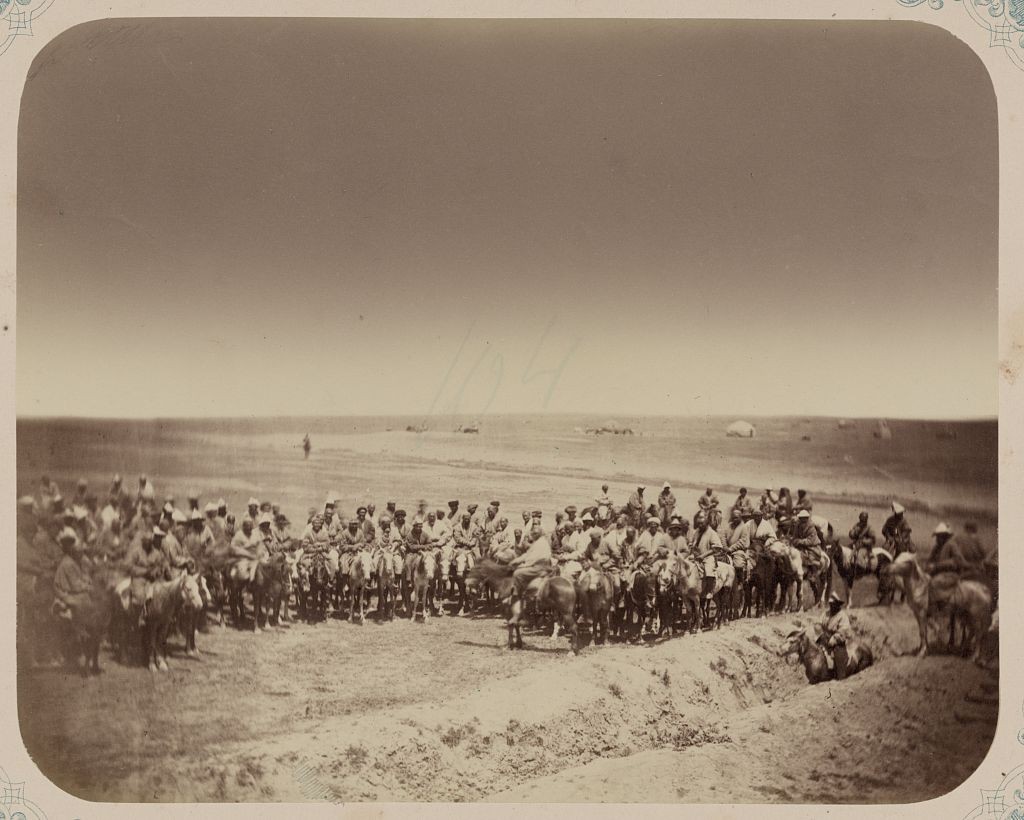
This older photograph belongs to Turkestanskii al’bom. The Library of Congress dates it to 1865–1872 and catalogues it under a title including “Kok beriu”. It cannot tell us when the game was invented. It can put a recorded scene well before today’s international tournament.
UNESCO’s account reaches beyond the scoreboard: players learn by watching and doing, experienced riders referee, and elders help keep the game fair. Professional, semi-professional and amateur teams all form part of the community. “Living heritage” makes sense here because the skill has to pass from one person to another.
It also travels. In the opening kok-boru match reported at the 2026 World Nomad Games, Kyrgyzstan beat the United States 16–7. K. Krombie’s report from the arena describes the Americans scoring in every period. That is a match between people learning and practising a sport, not just an unusual object going viral.
Our short begins with the shock of the “ball”. On a second watch, follow the rider instead: the reach, the balance, the turn towards the tai-kazan. The hook gets you to look. The skill gives you a reason to keep watching.
Find the game, then make the trip
“Want to feel the ground shake?”From the film
Cholpon-Ata is a real place to start looking: the World Nomad Games organiser records kok-boru matches at its Kok-Boru arena in September 2026. That is evidence of a venue, not a promise that a game will be running when you arrive. Confirm an upcoming fixture with the organiser or a local host before planning a journey around it. The photographs on this page show the 2018 Games, not the 2026 matches.
You came for the goat.
Stay for the rider who can lift it, keep it and find the goal.
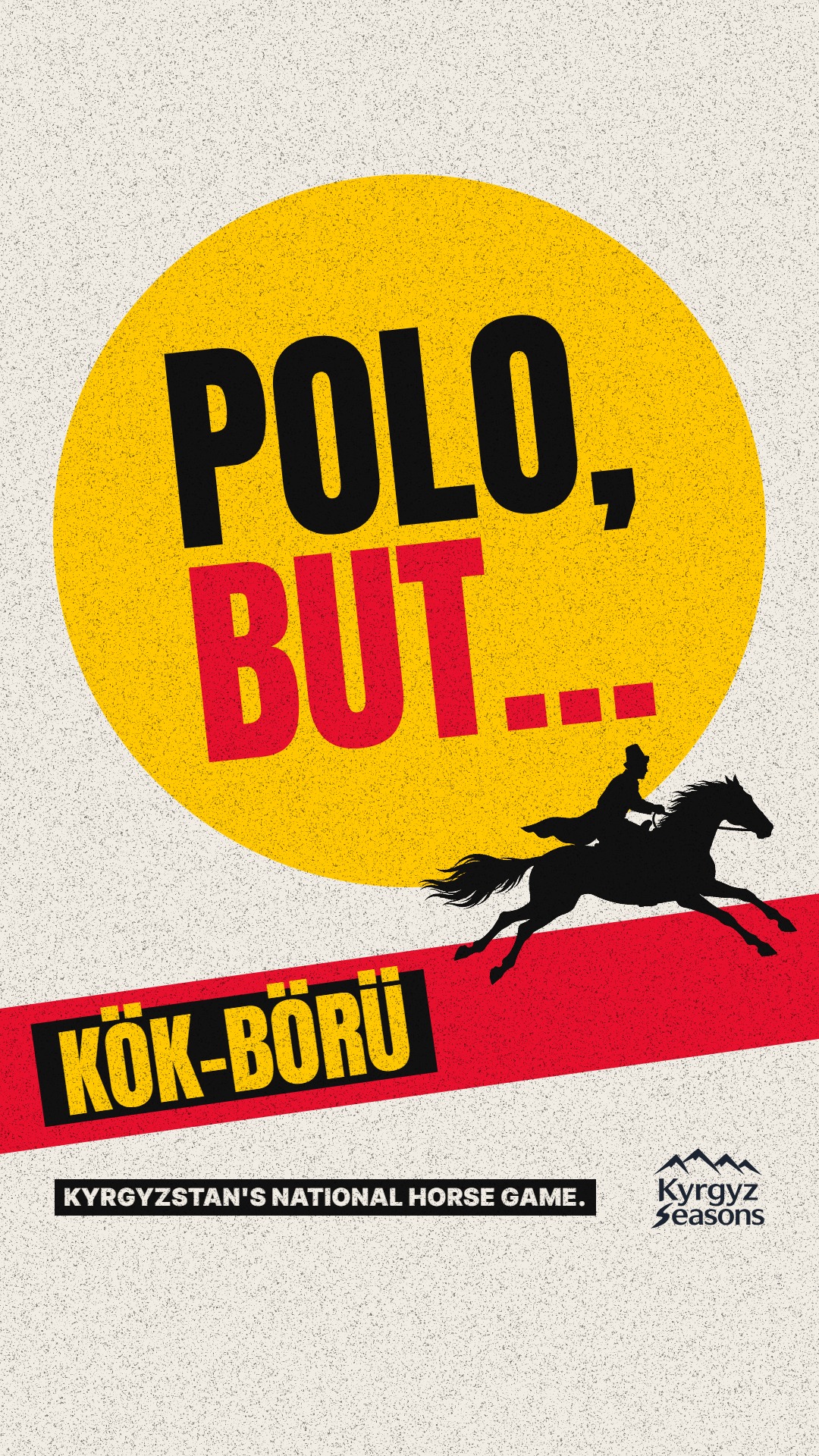 Watch the 55-second filmThe original short: yellow paper, red cut-outs, galloping riders and a very heavy substitute for a ball.
Want to see it for yourself?
Routes, places and the best months to go — everything for planning a trip to Kyrgyzstan.
Sources
- UNESCO: Kok boru, traditional horse game — inscription and living practice.
- Kok Boru Federation: Rules of the Game — headed 2024; hosted for the 2026 Games. Sections 6–9 and 13.
- UNESCO ICM: Kok boru — name and proposed origin.
- Maksatbek Anarbaev: Pastoralists and Predators in Alai — doctoral thesis, wolf legend (printed p. 189).
- Library of Congress: Kok beriu — photograph dated 1865–1872.
- K. Krombie, The Times of Central Asia — eyewitness match report, 2 September 2026.
- World Nomad Games: day-two kok-boru report — venue record, 3 September 2026.
Pictures
- World Nomad Games, Kok-boru — Helen Owl, 7 September 2018, Cholpon-Ata. CC BY-SA 4.0. Resized and JPEG-compressed; colour unchanged.
- Kok-boru 2018 — Helen Owl, 7 September 2018, Cholpon-Ata. CC BY-SA 4.0. Resized and JPEG-compressed; colour unchanged.
- Kok beriu, Turkestanskii al’bom — photographer unrecorded in catalogue, 1865–1872. Library of Congress, LC-DIG-ppmsca-14342. No known restrictions on publication; public-domain historical photograph. JPEG recompressed; original colour retained.
- Cover and four film frames — Kyrgyz Seasons, Kokboru-en-v3. These are motion-design illustrations, not documentary photographs. Hero, field and throwing diagrams drawn in code.
- Anton — Vernon Adams, SIL Open Font License 1.1. Latin subset; licence retained with the page’s editorial evidence. Body text uses the site’s Piazzolla and Golos Text.