


The tower. The spider. The missing half.
A legend fills the empty sky. The bricks tell a different story.
Watch the film · 63 sA tower against
a prophecy.
The first thing Burana asks you to imagine is something that is no longer there. A cylinder of brick stops against the sky. Our film puts a red, broken line above it: an invitation to picture the missing part, then to ask what happened.
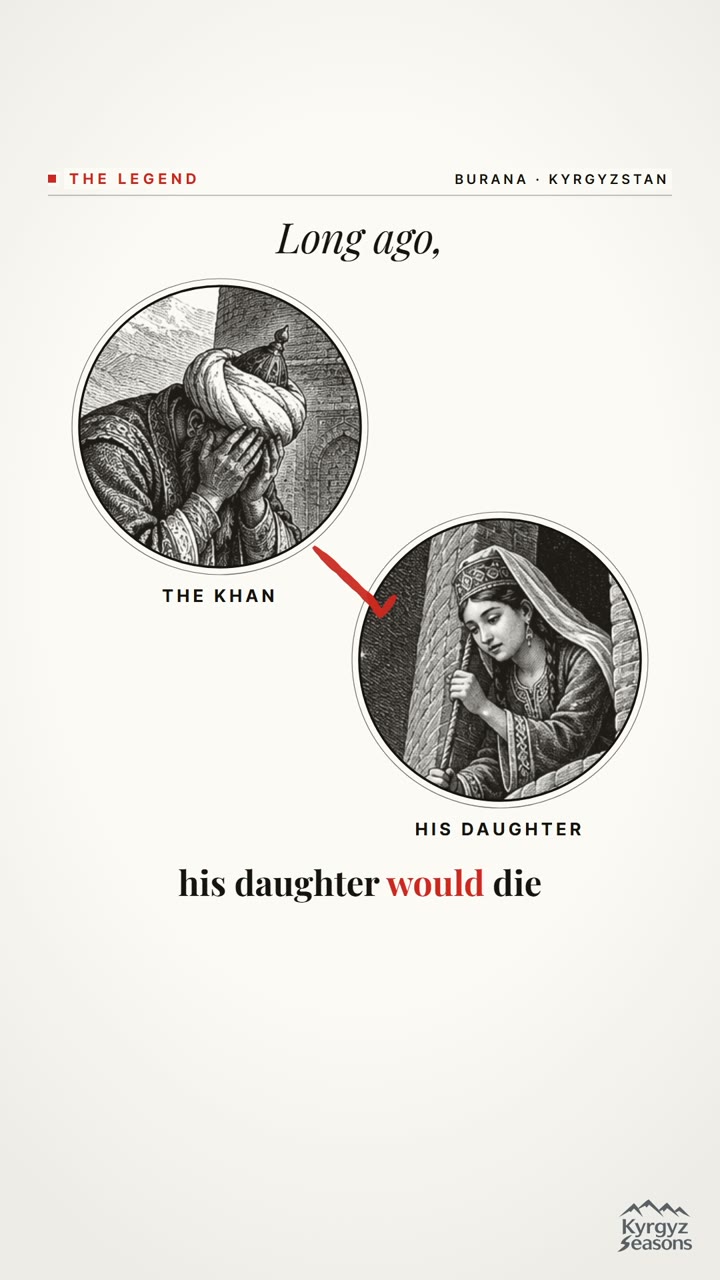
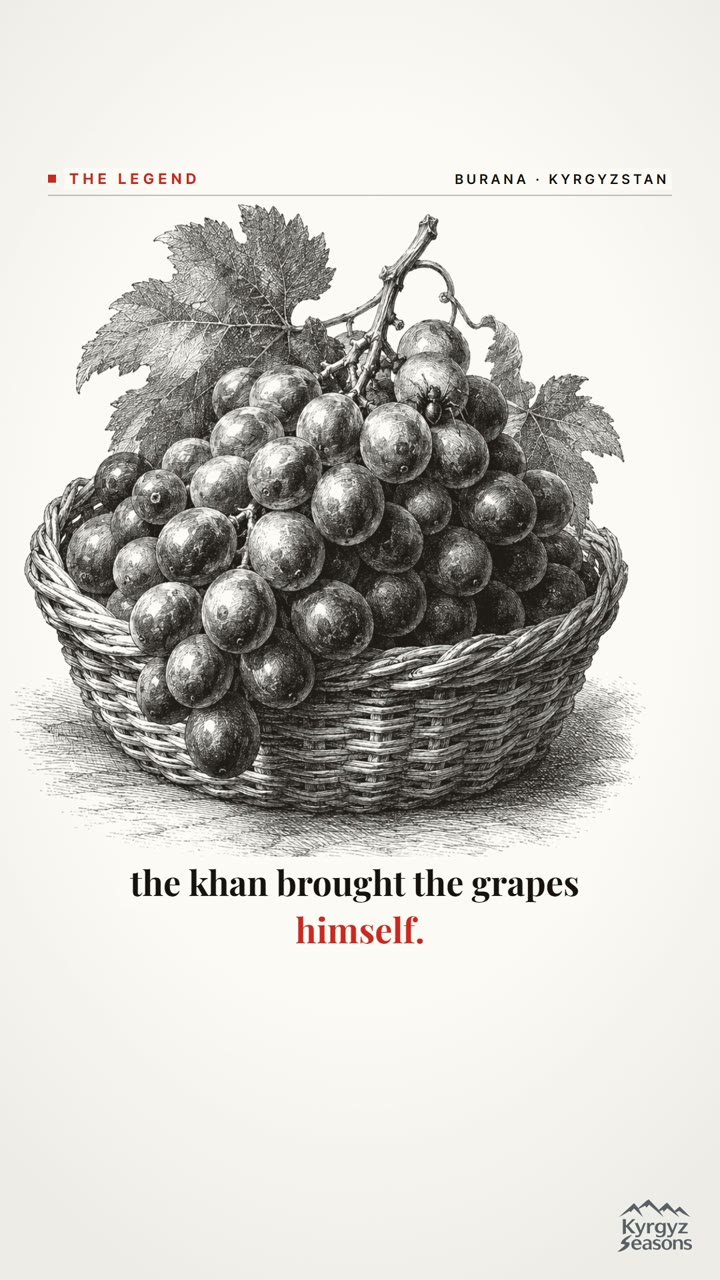
In the legend retold by CBT Kyrgyzstan, a khan tries to protect his only daughter from a prophecy: she will die on her sixteenth birthday. He shuts her away in a tower. The danger arrives anyway, hidden among the grapes brought to her on that birthday. A spider’s bite defeats the father’s precautions.
The smallest thing gets through. In the story, it is a spider among the grapes.
An illustration of the tale · not a historical objectIt is a story about care becoming confinement, and about the limits of a person’s power over another life. The tower makes that idea visible. High walls promise safety; the smallest creature slips through. You can remember this image without treating the princess as an archaeologically documented resident.
The same local account gives the father’s grief a part in the tower’s destruction. Keep that ending inside the folktale. A legend explains a ruin through human feeling. The next question asks what the surviving building can tell us.
From a princess’s tower
to a minaret.
Razan Aykaç’s architectural study identifies Burana as the minaret of the city’s Friday Mosque. That changes the building’s role. Instead of a private refuge raised against a prophecy, imagine a structure belonging to the public and religious life of a city.
The ICOMOS evaluation describes the surviving minaret at roughly twenty-four metres; CBT gives 24.6 metres. The useful point here is its interrupted form, rather than a contest over rounding. The local historical account attributes the loss of the upper part to an earthquake. The dashed outline on this page represents absence. It is not a measured reconstruction of the original top.
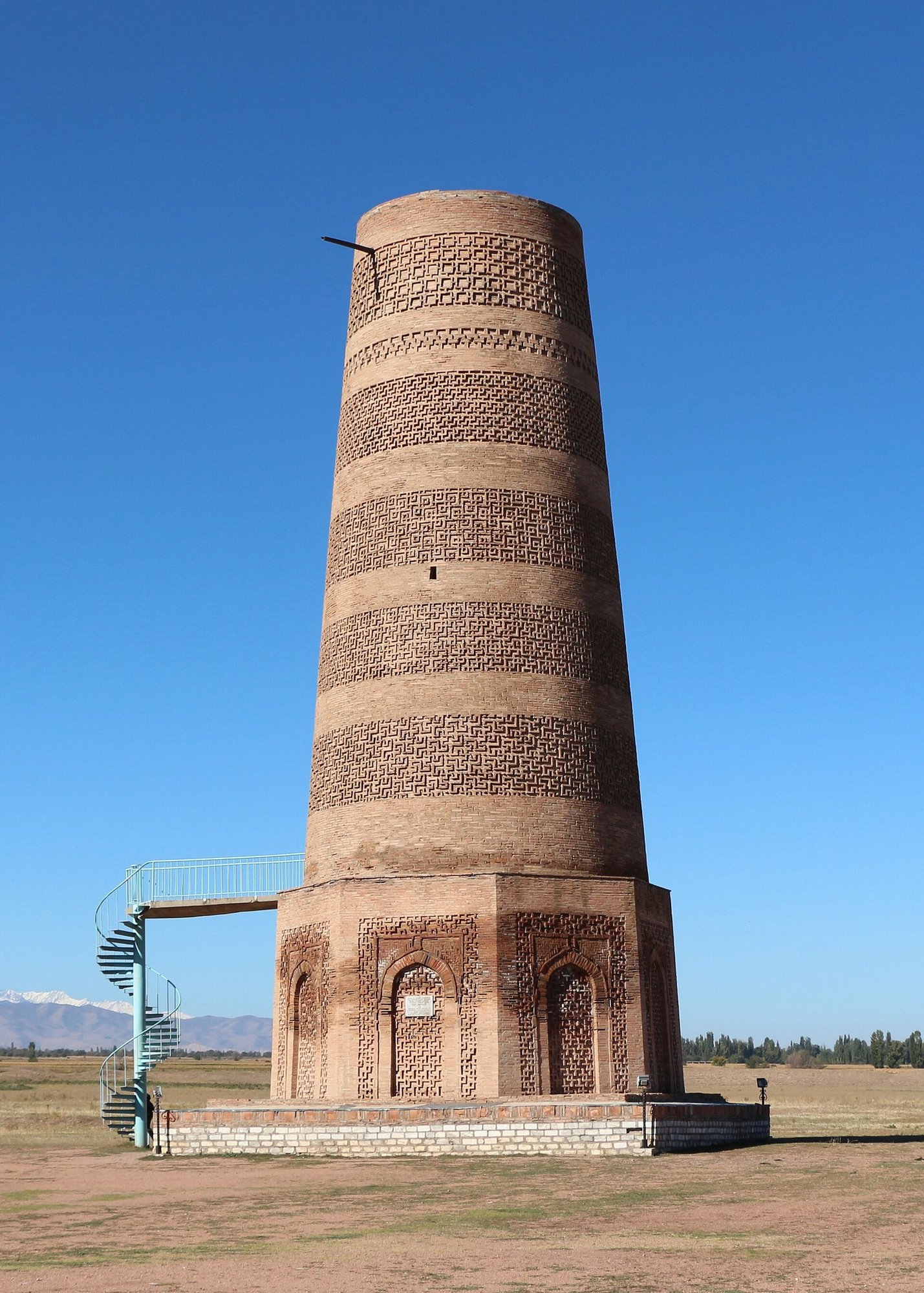

Begin at the base of the photograph and follow the shaft upward. The outline narrows, while smooth bands alternate with bands of small, repeated brick patterns. These details are visible in the photograph: you do not need to invent the missing rooms to find something worth looking at.
Then let your eye reach the cut-off rim. The broken silhouette holds two kinds of attention at once: the pleasure of a story and the patient work of looking at a structure. Neither requires pretending that a drawn completion is surviving evidence.
One tall survivor.
A much larger place.
ICOMOS places Burana within Balasagun, a planned Islamic city of the tenth to fourteenth centuries and a capital of the Eastern Kaganate. The tower is the easiest part to recognise from a distance. That visibility can make the rest of the place disappear from the story.
In 2014 the site became part of the UNESCO World Heritage property covering the Chang’an-Tianshan Corridor. This is a group of thirty-three components across China, Kazakhstan and Kyrgyzstan, rather than a designation for a lonely tower alone.
Kazakhstan
Kyrgyzstan
UNESCO describes a network that carried trade, beliefs, techniques and cultural practices. Think of a city as a place where journeys paused, people met and exchanges took shape. The name “Silk Roads” becomes more useful when it leads your attention from a line on a map to the places along it.
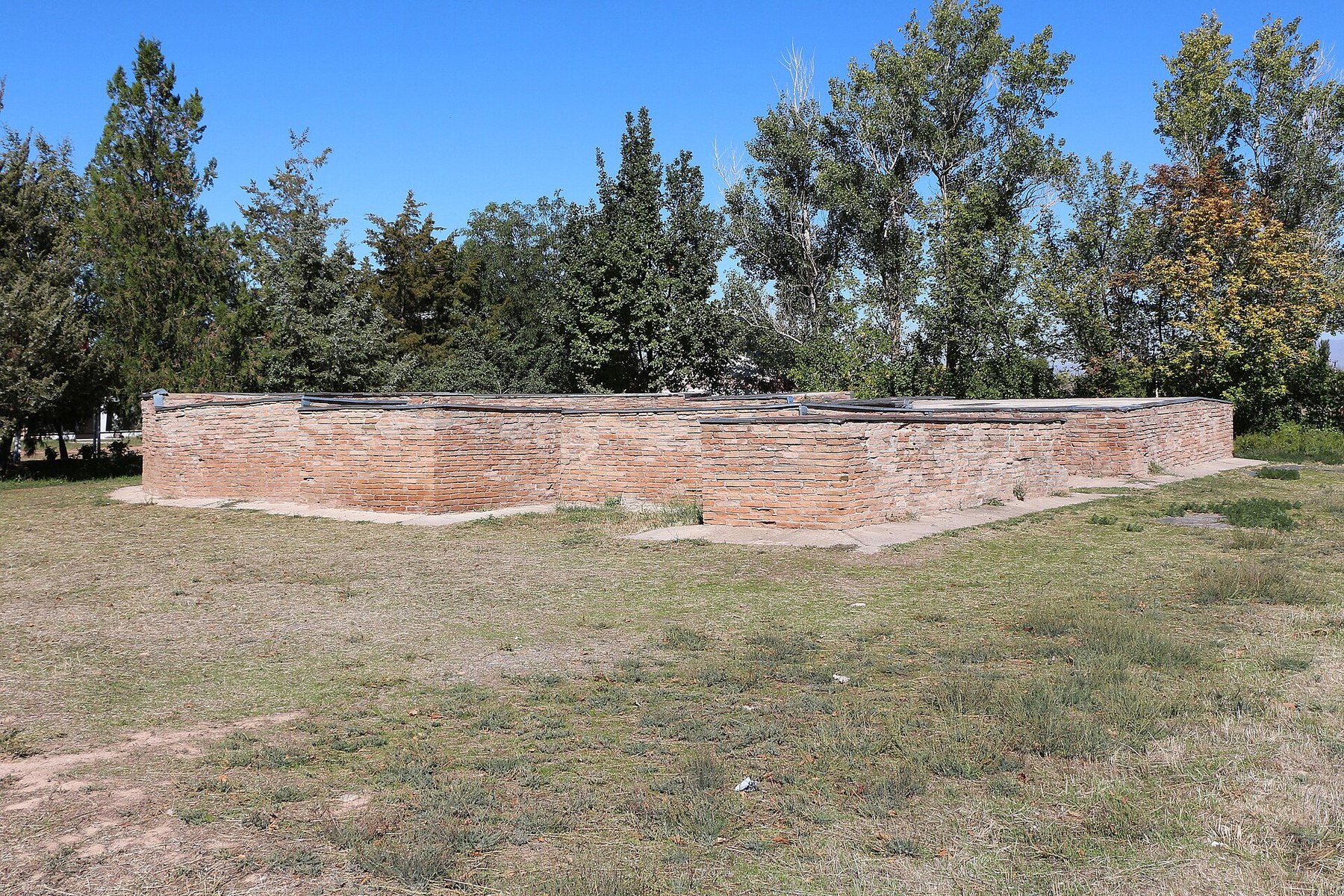

The low brickwork in this photograph belongs to mausoleum remains, identified in the photographer’s record. It asks for a different pace from the tower. Walk around the outline; notice what is present at ground level. A ruin does not need to stand high to make a place legible.
The field
looks back.
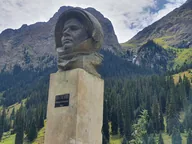
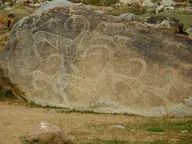
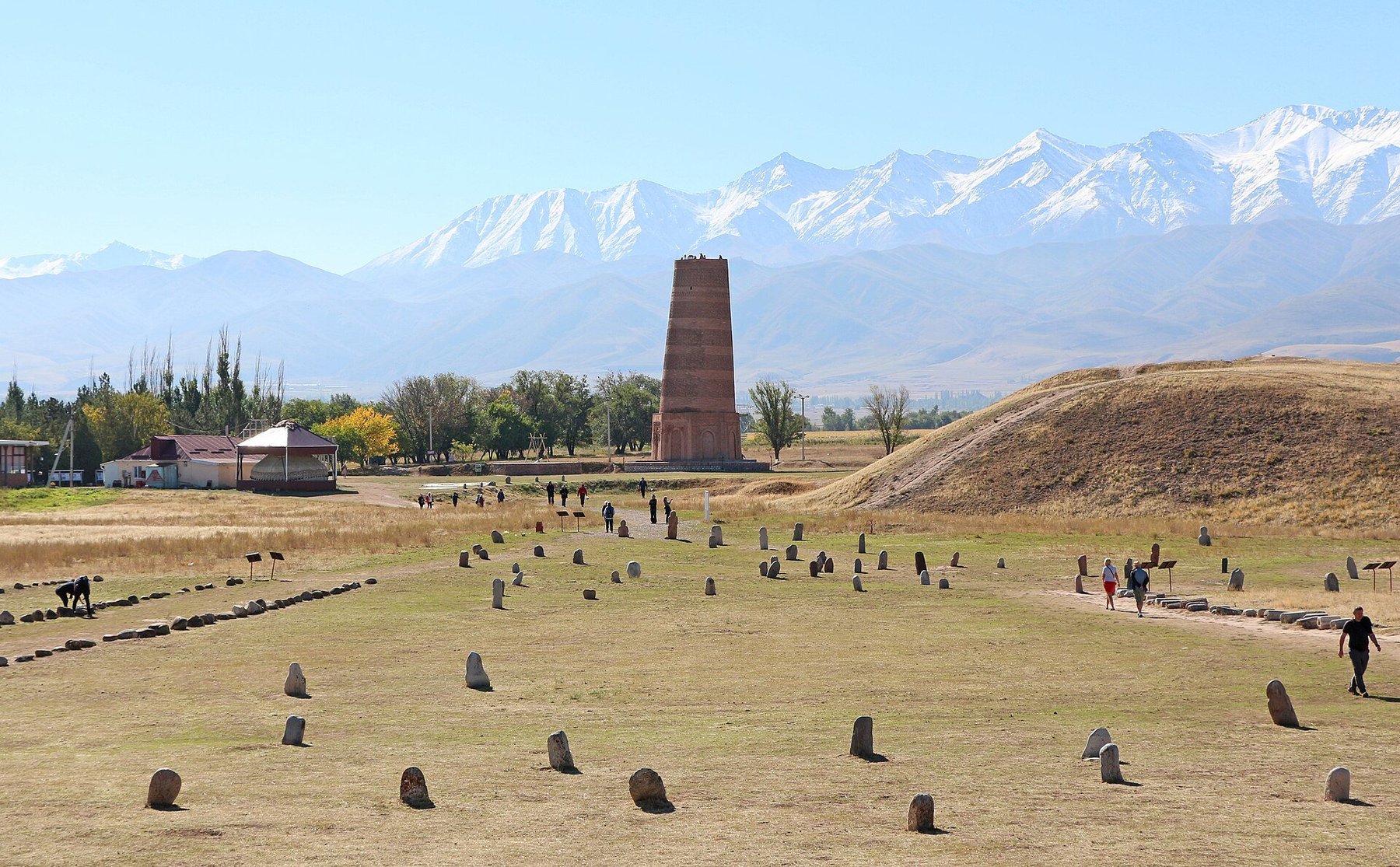
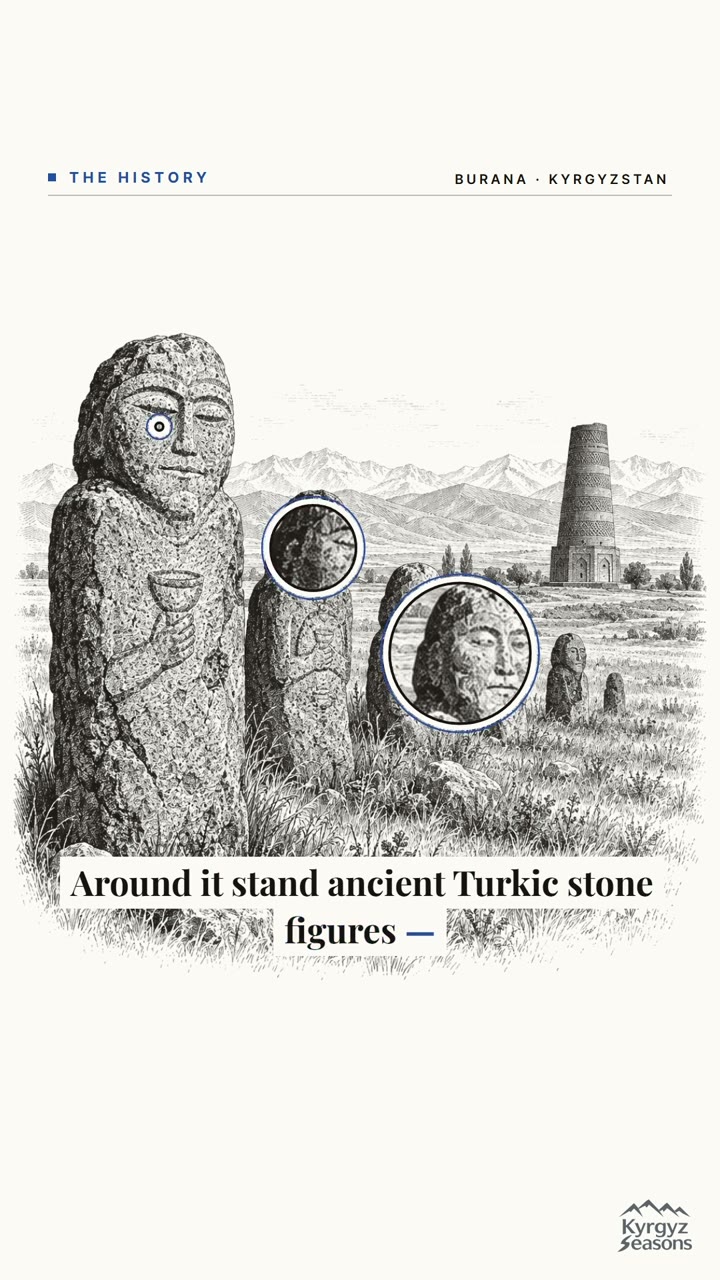
Stone figures, often introduced to visitors as balbals, stand in the open-air museum. Aykaç’s study explains that figures were brought here from different places in the surrounding region. Their arrangement today is a museum setting; do not assume that every figure has always stood on this patch of grass.

Give one face the attention you gave the tower. Look for the brows, the line of a mouth, a hand or an object held against the body. Some details are distinct; others have become difficult to read. Leave an uncertain shape uncertain. You do not have to turn every stone into a named person.
From here, look back across the field. The tower is smaller now. The visit has widened from one dramatic absence to a city site, its collected objects and the landscape around them. The princess and the spider remain a memorable way in. They are no longer the only things you came to see.

Begin outside. Then ask about the stairs.
“And check for spiders.”From the film
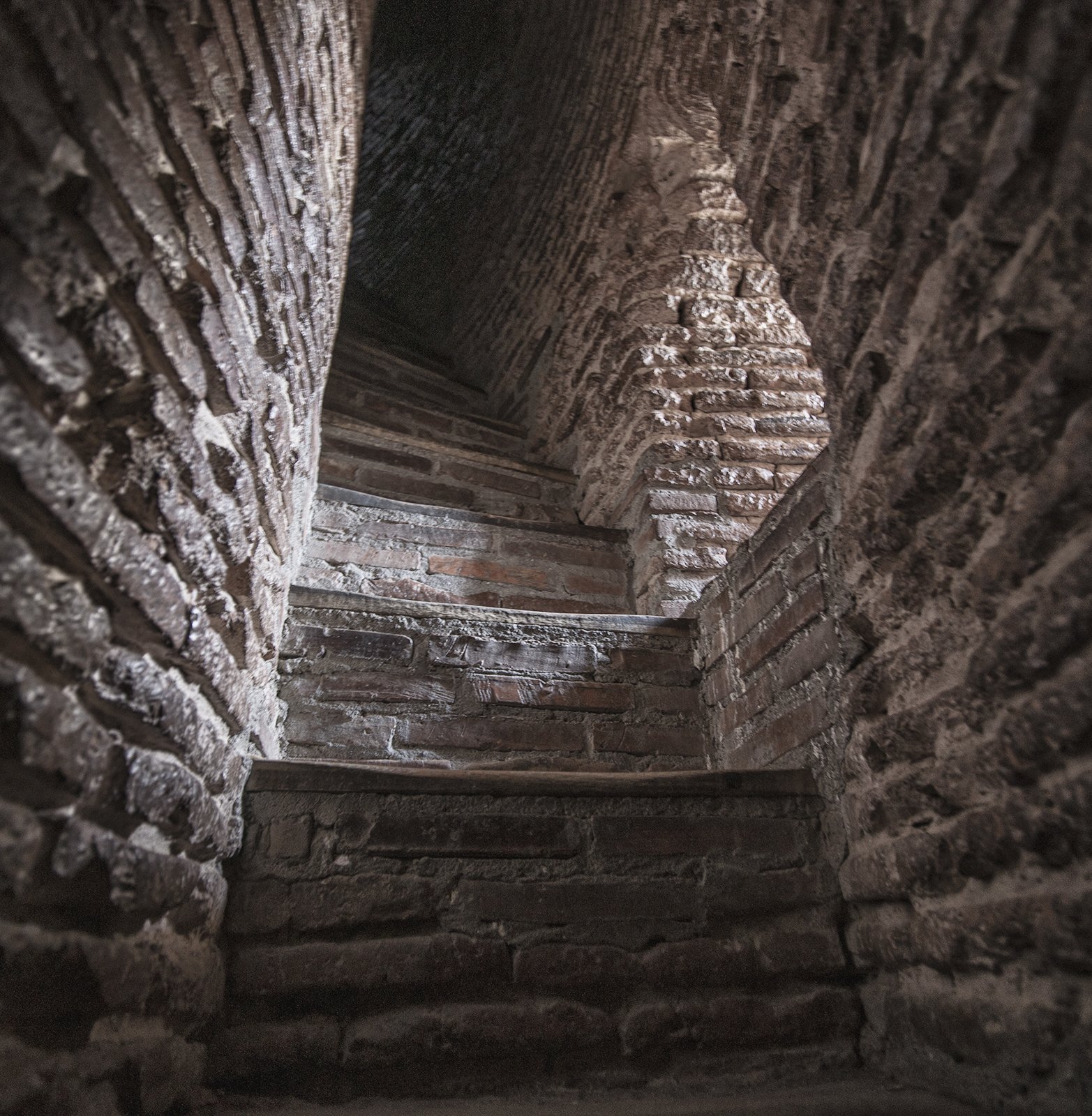
The joke belongs to the film; the narrow staircase belongs to the real building. Vilya Shoni’s photograph shows how closely the brick walls enclose the steps. Ask the museum staff whether the tower is open to climb that day. You can explore its silhouette, the masonry and the wider archaeological site without making the ascent.
Leave room for both stories.
Remember the spider. Look closely at the bricks.
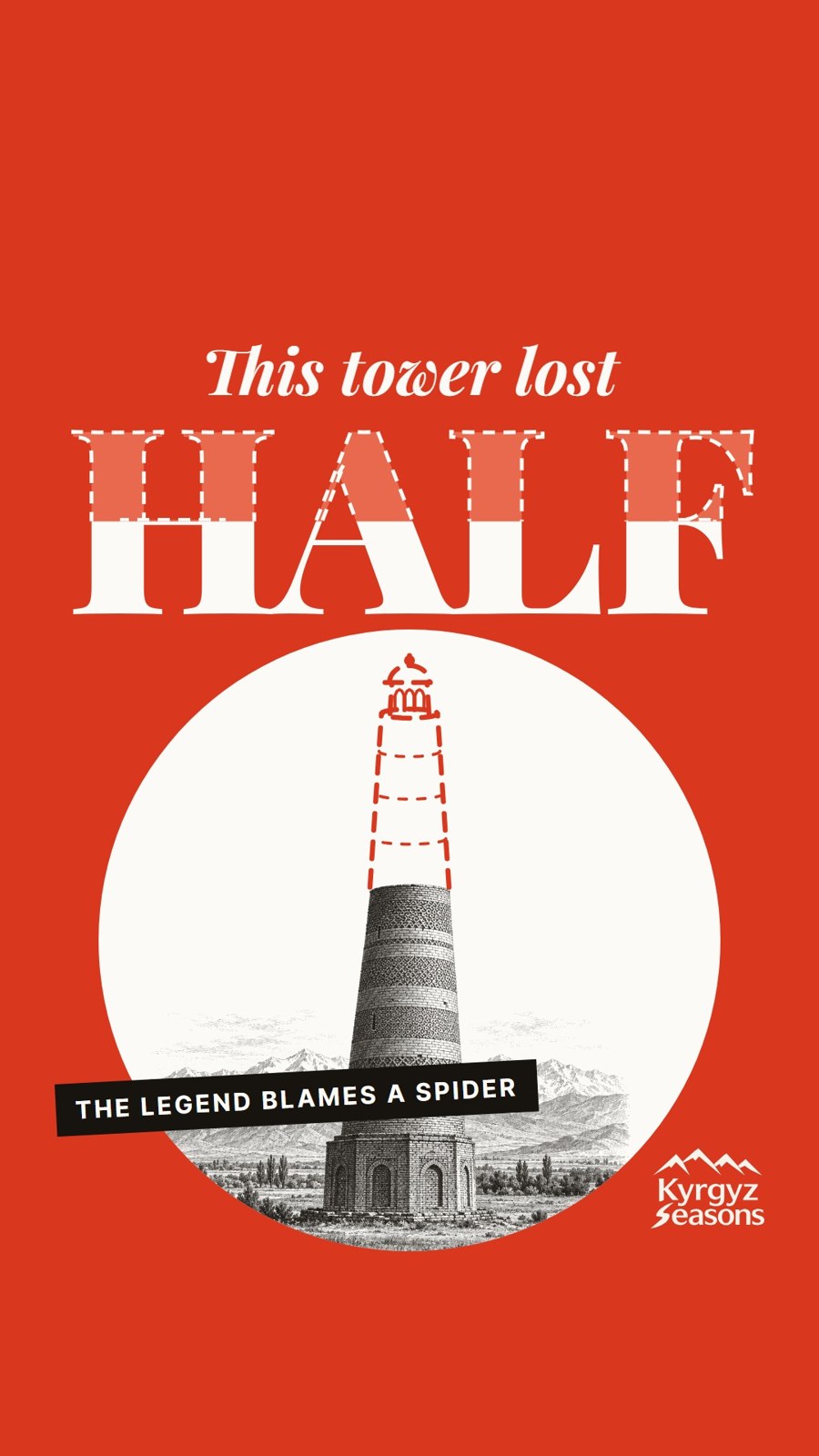 Watch the 63-second filmThe Tower and the Spider — the original short film, told through animated engravings. Its illustrated scenes are artistic interpretations.
Want to see it for yourself?
Routes, places and the best months to go — everything for planning a trip to Kyrgyzstan.
Sources
- CBT Kyrgyzstan: Burana Tower — a local telling of the legend, separately from the historical explanation.
- ICOMOS evaluation, 2014 — Balasagun and the Central Asian Silk Roads settlements.
- Razan Aykaç, 2022, DOI 10.30692/sisad.1073168 — the minaret, archaeological site and museum collection.
- UNESCO World Heritage Centre — the Chang’an-Tianshan Corridor and its inscription.
- Vilya Shoni: Burana tower 03 — staircase photograph, 8 March 2016.
Pictures
- Tower — Bernard Gagnon, 25 September 2023, CC0 1.0.
- Mausoleum remains — Bgag, 25 September 2023, CC0 1.0.
- Stone figures and tower — Bgag, 25 September 2023, CC0 1.0.
- Interior staircase — Vilya Shoni, 8 March 2016, CC BY-SA 4.0.
- Documentary photographs resized and JPEG-compressed; original colour retained. Display crops are indicated beside the photographs. Cover and four film frames: Kyrgyz Seasons, artistic illustrations from the 2026 film. The coded tower, basket and print overlays are conceptual illustrations, not measured reconstructions.