












They Burned an Empire. Then Went Home.
A capital burned. A princess was sent home. The victors turned north. Follow the story beyond the final frame.
Watch the film · 41 sA capital in flames
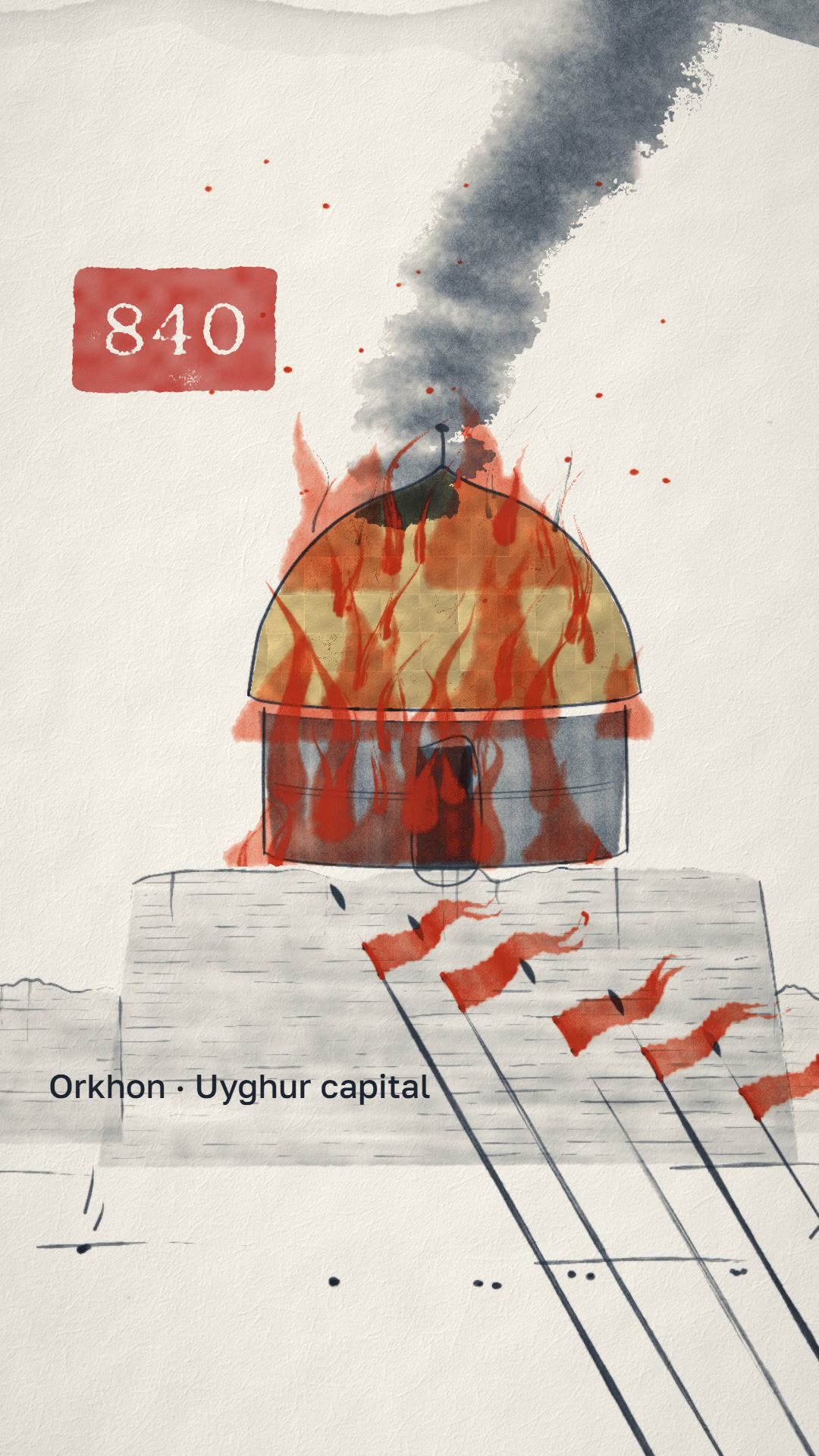
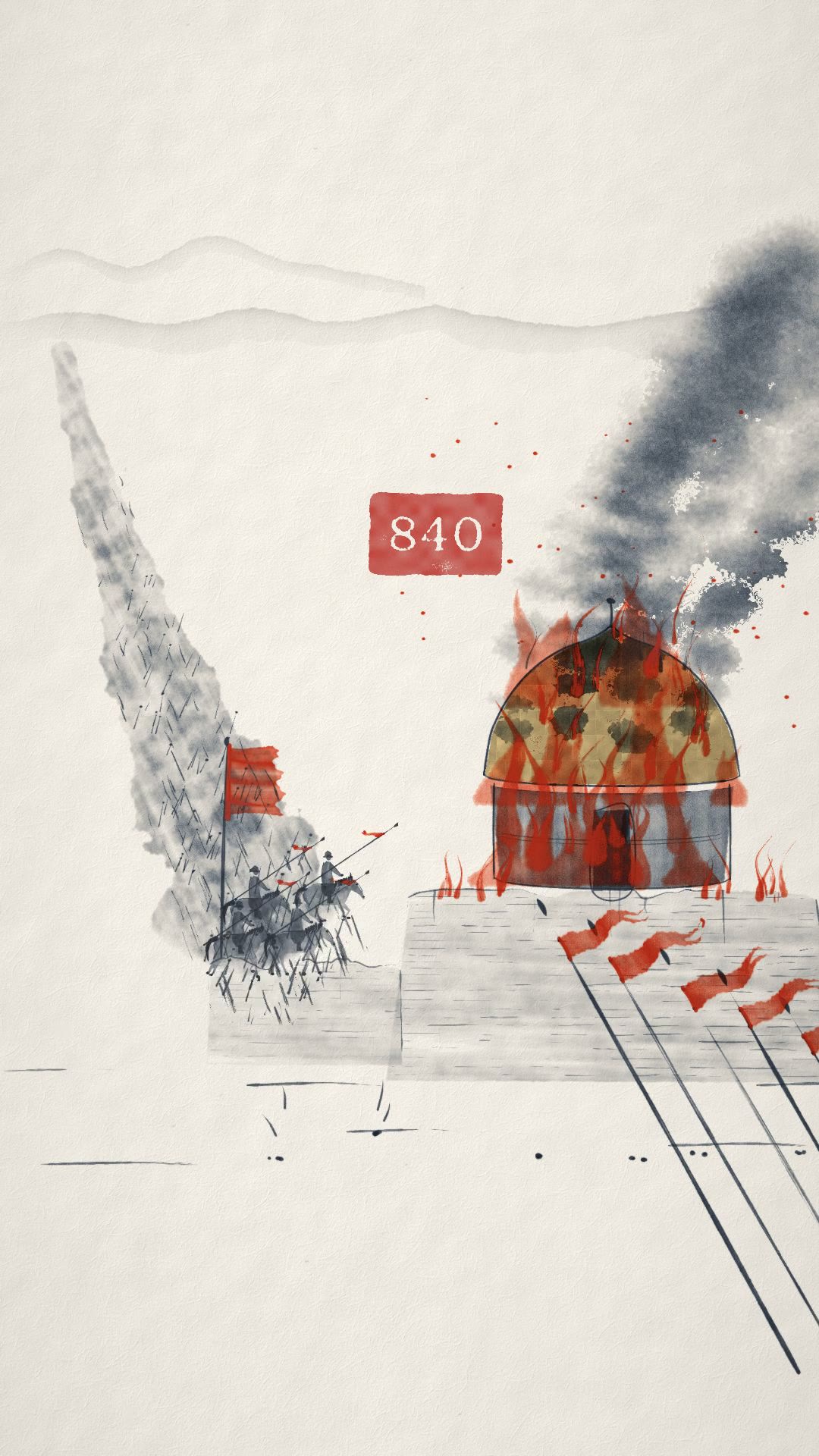
The riders reach the capital. The khagan dies. His headquarters burn. In the short film, that moment fills a paper scroll with red. The written account is almost as abrupt.
The New Book of Tang describes a Uyghur leader joining forces with the Kyrgyz to attack the Uyghur city. It reports the killing of the khagan and the burning of his headquarters. This is the event behind the film’s opening: the fall of the Uyghur imperial centre in 840.
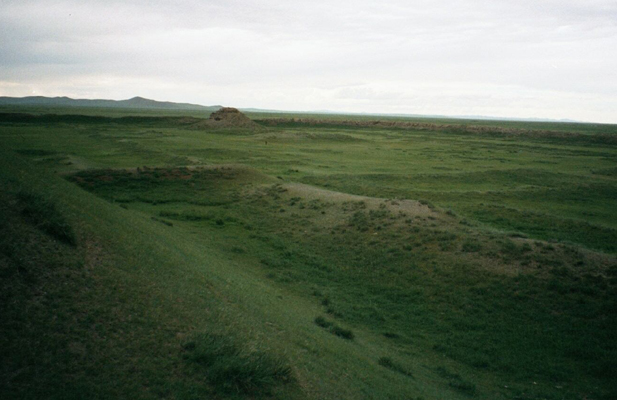
The place was Ordu-Baliq, also called Khar Balgas, in what is now Mongolia. It belongs to the Orkhon Valley landscape, where the remains of cities sit within a much larger pastoral world. The name Kyrgyz connects this story with Kyrgyzstan; the battlefield itself lies in another country.

A hundred thousand riders?
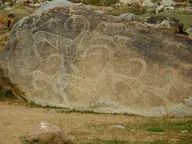
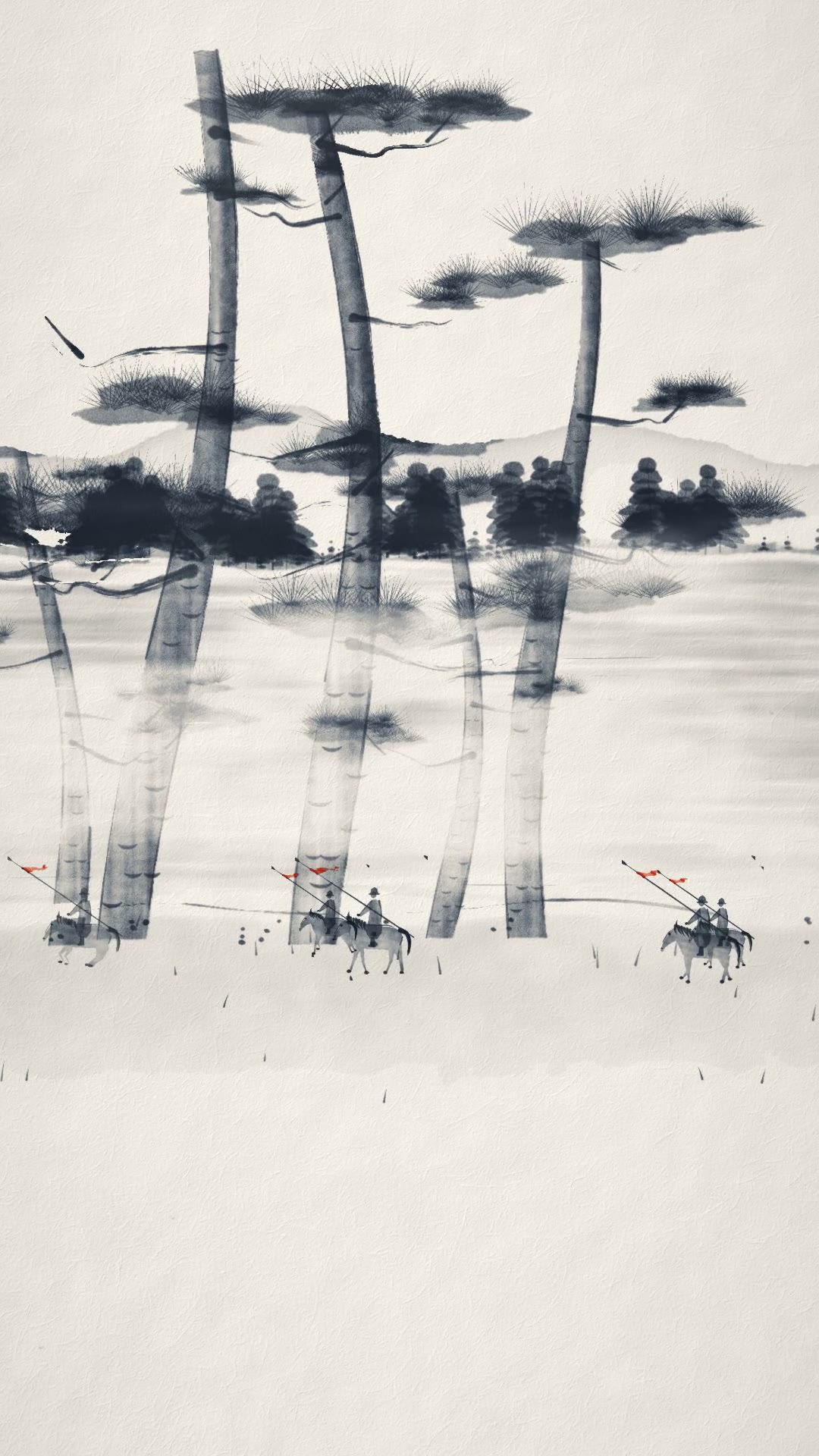
An ink impression. The riders are not a scale model.
A Uyghur leader joined the Kyrgyz. The account gives their combined mounted force as one hundred thousand.
The number is preserved in a written source. It is not an independently verified count of the army. A precise-looking number can still carry uncertainty.
The film gives the army a number: one hundred thousand. That number comes from the Chinese account, which describes the combined mounted force. It is a reported figure, rather than a count independently established by modern historians. There is a difference between saying that a chronicle names an enormous army and knowing exactly how many horses crossed the plain.
The same account gives the catastrophe a setting. Before the attack, the Uyghur court had suffered internal conflict, hunger, epidemic disease and heavy snow that killed livestock. The riders entered a world already in crisis. The fire is the film’s sharpest image, but it is only one part of the collapse recorded on the page.
A person inside the victory
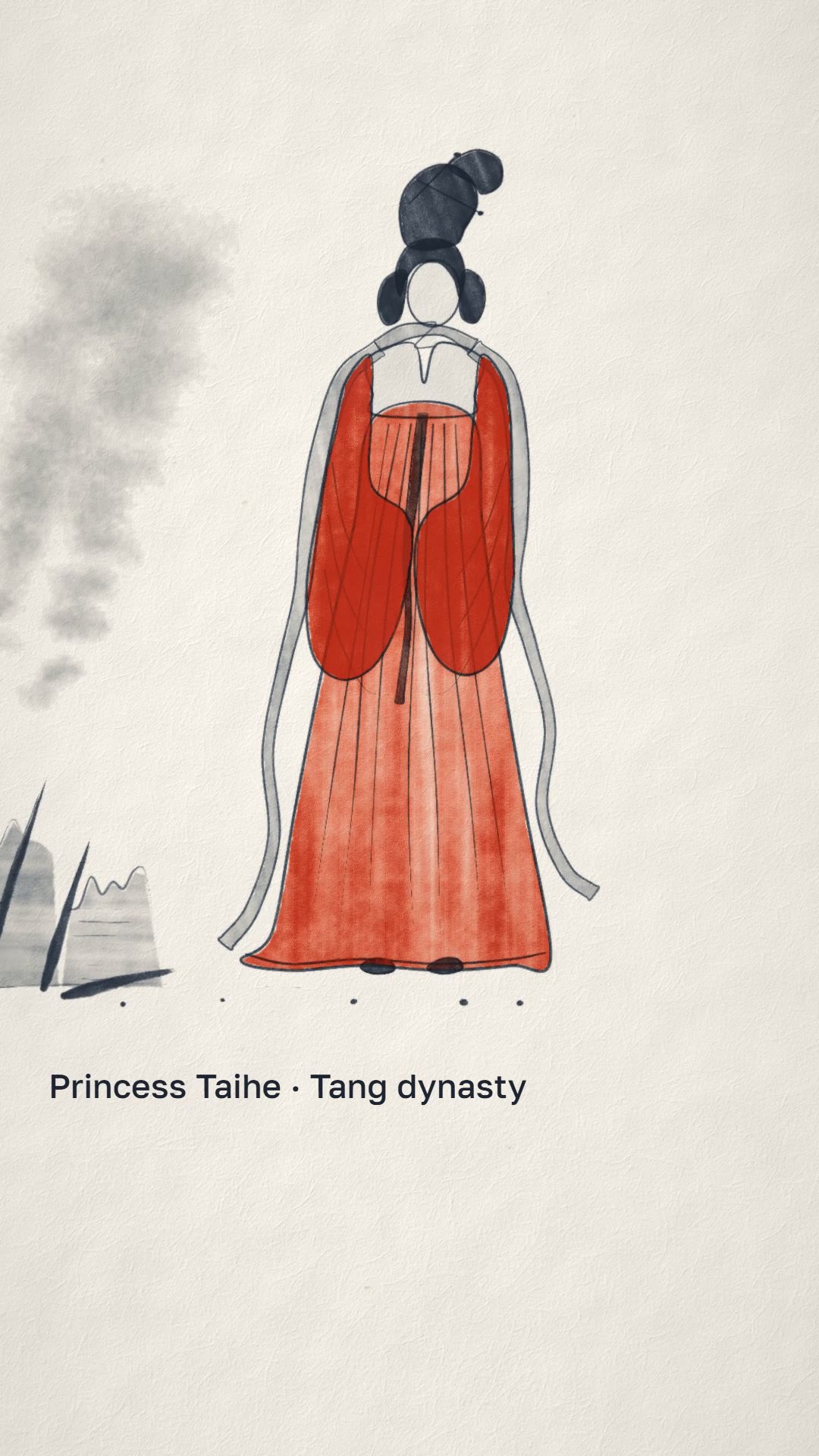
01CapturedA Tang princess at a fallen court
Taihe was a daughter of Emperor Xianzong and a Uyghur royal consort. The Kyrgyz obtained custody of her after the defeat.
02Sent homeAn escort, and a claim of kinship
The Kyrgyz sent an envoy to escort her back to Tang territory, invoking their claimed shared lineage with the ruling house.
03InterceptedThe journey did not end there
Wujie pursued the escort, killed the envoy and took the princess. Shi Xiong later encountered her after fighting Wujie’s forces and brought her back.
Among those caught in the defeat was Princess Taihe. A daughter of the Tang emperor Xianzong, she had been sent to marry a Uyghur khagan. The Chinese account describes an elaborate marriage ceremony and her installation as a khatun, a royal consort. In the film, her red figure interrupts the grey mass of the army. In the source, her presence links two courts.
The Kyrgyz obtained custody of her after the defeat. They then sent an envoy to escort her back to Tang territory. The film compresses this into a caravan heading home. The chronicle makes the next part much less peaceful.
The Uyghur leader Wujie pursued the escort, killed the envoy and took the princess. Later, the Tang commander Shi Xiong encountered her after fighting Wujie’s forces and brought her back. Sending her home and getting her home were separate events. The return was interrupted by another struggle for power.
“One family”
A documented claim. A legendary ancestry.
The chronicle records the Kyrgyz claim of descent from Li Ling. Recording a genealogy does not independently prove it.
Why send a captured princess back? The Chinese history supplies a reason: the Kyrgyz claimed descent from the Han general Li Ling and regarded themselves as belonging to the same lineage as the Tang ruling house. In the film, one painted root divides into two branches.
That image needs a careful caption. The claim of kinship is documented; the genealogy itself is a tradition, not a demonstrated family tree. A diplomatic assertion can be a historical fact without the ancestry it asserts becoming proven. Here the story preserves the claim and leaves the legendary descent labelled as such.
The princess’s escort belongs in this diplomatic setting. The source connects the act with the professed relationship. It does not give us access to every motive of the people who made the decision. A scene on a scroll can suggest a feeling; a historical account must stop where its evidence stops.
Winning was not staying
Then comes the turn that gives the film its ending: the victors leave. Historian Michael Drompp challenges the familiar picture of the Kyrgyz simply inheriting an empire centred on the Orkhon. His argument places their continuing base in the Yenisei region, rather than in the conquered imperial heartland.
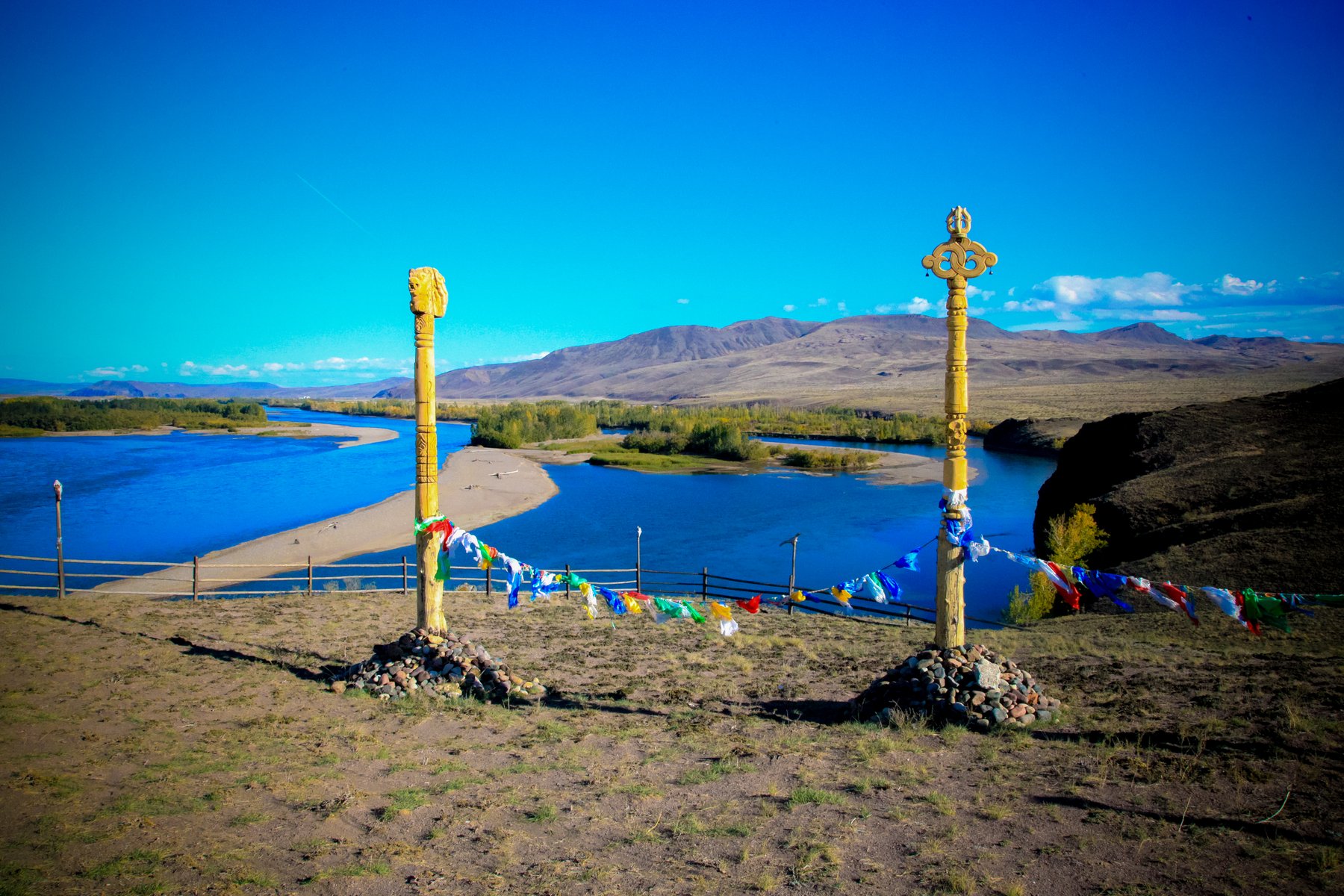
Two political centres in Drompp’s interpretation. A visual transition, not a reconstructed route.
“They rode home” is the film’s shorthand for that interpretation. It should not imply that every warrior departed at once, that all fighting ended with the fire, or that the extent of later Kyrgyz power is settled. The Chinese account itself continues with further Kyrgyz campaigns after the capital’s destruction.
The historical question is therefore larger than a retreat after a battle: where did the victors choose to centre their power? Drompp’s answer makes the north essential to understanding the aftermath. It is a scholarly argument about political geography, rather than a record of one homeward procession.

What the scroll leaves open
The film ends where it began, with the vanished imperial seat. “Everyone went home” closes the loop. The longer account keeps the complications: a princess whose escort was attacked, an army known through a chronicler’s number, and victors whose relationship with the conquered territory remains a question for historians.
The ruins can still be visited in Mongolia’s Orkhon Valley. UNESCO includes Khar Balgas among the landscape’s remains and describes the valley as a meeting ground of pastoral societies and their administrative and religious centres. This is not a stop in Kyrgyzstan, and no Kyrgyzstan itinerary is presented here as a substitute for the battlefield.
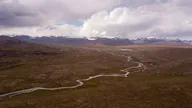
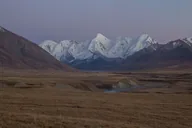
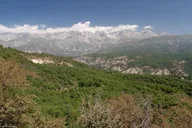
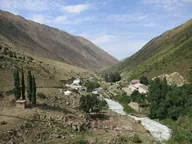
The ink gives the story a single, memorable movement: towards the capital, then away from it. The photographs leave something quieter on the paper — earthworks in grass and a river in the north. Between them lies the distinction at the heart of this story: taking an imperial centre and making it home were different things.
The capital burned.
The north remained home.
A short film closes the circle. History leaves the edges open.
 Watch the 41-second filmAn imperial seat, a red-robed princess and riders turning north, painted on a single paper scroll. Stills appear in the chapters above.
Want to see it for yourself?
Routes, places and the best months to go — everything for planning a trip to Kyrgyzstan.
Sources
- New Book of Tang (Xin Tang shu), chapter 217, lower part. Chinese primary text.
- Michael R. Drompp, ‘Breaking the Orkhon Tradition: Kirghiz Adherence to the Yenisei Region after A. D. 840’, JAOS 119(3), 1999, 390–403. doi:10.2307/605932.
- UNESCO World Heritage Centre, Orkhon Valley Cultural Landscape.
Pictures
- Ordu-Baliq: James A. Glazier, date listed by Commons: 21 February 2006. CC BY-SA 3.0. Original 617 × 400 file retained; not recoloured.
- Yenisei at Aldyn-Bulak: Zamunu45, 19 September 2015. CC BY-SA 4.0. Resized to 1800 px, not recoloured. The photograph retains its stated licence.
- Cover and four film stills: Kyrgyz Seasons, ‘840’, 2026. Stylised ink illustrations from the supplied film, not documentary photographs. Interactive landscapes: Canvas compositions of the original film’s procedural pigment layers. Paper texture and brush masks are drawn in code. These are illustrations, not reconstructions or photographs.