

Traveller’s question
Food and customs in Kyrgyzstan: what to try, how to behave, 25 phrases
In Kyrgyzstan it is worth trying beshbarmak, lagman, plov, manty and samsa, and in Karakol ashlyan-fu; among drinks, tea and, in summer, kymyz, maksym and chalap. Lagman, plov and manty in simple cafés cost roughly 200–500 som a portion, and samsa from 30 to 150 som, but prices depend on the town and the establishment. When you are a guest, take off your shoes, sit where you are shown, take at least a little of what is offered and do not put bread on the floor. Ask people for permission before photographing them. A few phrases in Kyrgyz get a warm response, although in the cities Russian is usually enough. check for your date
Updated 13 October 2026
- 9 dishesand 7 drinks and sweet things worth trying
- 200–500 soma portion of lagman, plov or manty in simple cafés, 2026
- Take off your shoesin a yurt and in a house; the guest’s place is opposite the entrance
- 25 phrasesEnglish, Kyrgyz, Latin letters
Dishes
Nine dishes worth trying
What to order in a café and what you are most likely to be offered at home. Prices are in a separate section below.
Beshbarmak Besh barmak
The national dish: boiled meat (traditionally horse, today more often mutton or beef) on wide homemade noodles with an onion broth. The name means “five fingers”: it is eaten with the hands. It is served at festivals, births and funeral meals.
Lagman
Hand-pulled noodles in a stew of mutton, potato, carrot, onion and radish; without the noodles it is shorpo. A vegetarian version is sometimes made if you ask for it “without meat”.
Ashlyan-fu
A Dungan dish, the calling card of Karakol: cold noodles in a sour and spicy sauce, in some versions with starch jelly and omelette. A summer dish; in Karakol many cafés serve it, with varying degrees of spiciness.
Plov Paloo
Rice with meat, onion and carrot, cooked in a kazan. Especially loved in the south; served to honoured guests.
Manty
Large steamed dumplings with mutton and onion, served with sour cream or vinegar. A portion is 4–6 pieces.
Samsa
A flaky pastry with meat and onion baked in a tandoor. Sold at bazaars and eaten on the go; pumpkin and potato versions exist.
Boorsok Boorsok
Pieces of fried dough. Served with tea at the festive table, in guesthouses for breakfast and at Nooruz; dipped in honey or tea.
Kuurdak
A roast of mutton or horse meat with potato and onion, fried in its own fat.
Chuchuk
Horse sausage. At festivals in Naryn and in the south it may be served sliced. The taste is rich and fatty.
Drinks and sweet things
Kymyz, maksym, chalap, tea and honey
Fermented milk and grain drinks are a local speciality. Try them in small amounts.
Kymyz Kymyz
Slightly sour, lightly fizzy, mildly alcoholic mare’s milk. Fresh kymyz is available roughly from May to August; it is offered in yurts and at roadside stops in the mountains. The taste is unfamiliar, and a sip is enough to begin with.
Maksym
A cool, lightly fizzy drink made from fermented grain. In summer it is sold from barrels on the street, especially in Bishkek.
Chalap
A fizzy fermented milk drink based on ayran, with water and salt; a mixture with maksym is called “aralash”. The sources differ slightly on the composition, so ask the seller.
Ayran
A fermented milk drink served chilled; you can find it in cafés with eastern cuisine.
Kaymak
Thick cream; it is eaten at breakfast with bread and jam, for example in jailoo camps.
Honey Bal
Honey is sold at markets, for example at the Osh Bazaar in Bishkek. Boorsok and bread are dipped in it.
Tea with milk Süt koshulgan chay
Tea is the main drink. It is drunk with milk, salt or sugar depending on the area; it is served with jam, bread and boorsok.
Where to go
Markets, teahouses and yurts on the jailoo
Three main places: the bazaar, a café or canteen, and the home table in a guesthouse or yurt.
- The Osh Bazaar in Bishkek
- The capital’s main market sells samsa and lagman, kurut and honey. Take hot food from a busy stall. Page: Osh Bazaar.
- Jayma in Osh
- Covered rows, fruit, dried fruit, nuts and spices; street food around the edges. It is best to go in the morning, when the aisles are clearer. More: Osh.
- Ashlyan-fu in Karakol
- It is served in many of the town’s cafés; an article from 2025 names, for example, “U Saidy”, “Krasny Drakon” and “Bapa No. 1”, while “U Takhminy” operates at the Bugu market. You can ask the owners about the spiciness and the ingredients. Pages: Karakol, Bugu Bazaar, Dungan Mosque.
- Cafés and canteens
- In the towns the staple is simple cafés with lagman, plov, manty and samsa; in Bishkek and Osh there are cafés marked “halal”. Beshbarmak is more often a festive dish, but it is also served in some traditional restaurants.
- Yurts and guesthouses
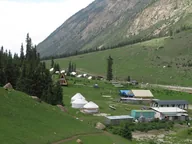
- On the jailoo, dinner is usually shared: beshbarmak, plov or manty, and for breakfast tea, bread, jam and butter. Most camps have no electricity or running water, and the toilet is in the yard.
- The Sunday livestock market in Karakol
- Not for eating but for watching: sheep, horses and tack on the edge of town on Sunday mornings. Come before nine, wear closed shoes and ask permission before photographing people.
Special cases
Vegetarians, halal, water and hygiene
In the towns the choice is wider; in villages and on the jailoo you will have to ask in advance.
- Vegetarians
- The cuisine is meat-based, so warn your hosts in advance. Bread, dairy, salads, vegetable soups, lagman without meat on request and sometimes pumpkin or potato samsa work. Vegans have a harder time: there is milk in tea, pastries and soups. The phrase: “Men et jebeym” (I do not eat meat) or, in Russian, “bez myasa” (without meat).
- Halal
- Most local food is made with beef and mutton. In Bishkek and Osh there are cafés marked “halal”; in smaller towns, ask directly and check the way of cooking and the sauces.
- Water
- Do not drink tap water: take a sealed bottle, or boiled or filtered water. Boiled water is “kaynatylgan suu”.
- Hygiene
- Take hot food from a busy stall, wash or peel fruit, and it is better to skip salads that have stood a long time in the sun. A hand sanitiser is useful at the market.
What it costs
Approximate prices for dishes
The ranges were checked on 13 October 2026 against a tourist article from May 2026, a market roundup from April 2026 and an undated Visit Kyrgyzstan overview. They are guides, not a price list.
- Beshbarmak
- 600–1,000 som in restaurants; another tourist site gives 3–6 USD, so the spread is considerable. check for your date
- Lagman
- about 200–500 som in simple cafés; in 2023 two plates of lagman with bread and tea were estimated at roughly 3 USD. check for your date
- Plov
- 250–400 som in a canteen, or 2–5 USD by another estimate. check for your date
- Manty
- 220–350 som for a portion of 4–6 pieces. check for your date
- Samsa
- 30–40 som at the Ortosay market in Bishkek (April 2026) and 80–150 som at kiosks. check for your date
- Kuurdak
- about 3–5 USD according to a tourist site; check the price in som on the menu on the date. check for your date
- Ashlyan-fu
- about 1–2 USD according to a tourist site; check the exact price of a portion in Karakol with the establishment on the date.
- Tea, snacks, water
- tea 20–60 som, a snack at the bazaar 80–200 som, a bottle of water 40–80 som. check for your date
- Kymyz, maksym, chalap
- prices are not fixed: check with the seller or hosts on the date.
Customs
In a yurt and in a home: shoes, the guest’s place, the threshold
Follow your host: customs differ by region and family.
- Shoes
- Take off your shoes before a yurt or a house, especially if there is a row of shoes at the entrance.
- The guest’s place
- The place of honour, the “tor”, is opposite the entrance, and a guest is usually seated there. Elders often sit nearer the entrance. Sit where your host indicates.
- The threshold
- We have not confirmed a single rule for the whole country. Simply do not step on the threshold and do not stand in the doorway.
- Tea in a half-filled bowl
- If tea is poured into half a bowl, it is a sign of respect and a wish for the guest to stay; a full bowl is poured when hinting that it is time to leave.
At the table
Dastarkhan, bread and tea
Offering food is the main form of hospitality.
- Dastarkhan
- A low table covered with a cloth. Begin eating after your host’s invitation. If you are called to the table, take at least a little.
- Bread
- Bread (“nan”) is served first and treated with care: do not put it on the floor and do not turn it over. These are travellers’ accounts, not law, so watch your hosts.
- Omin
- At the beginning or end of a meal, people draw their palms down over the face (“oomin”). You can repeat the gesture; hosts appreciate it.
- Declining food
- A blunt refusal is unwelcome. Try a morsel, say thank you, and say “Men toydum” (I am full).
- Meat at festivals
- The best pieces go to the elders; if mutton is served, the head may be given to the most honoured guest, who shares it with the others.
Etiquette
Gifts, photos, clothing, alcohol, tips and haggling
The small things that make up how people regard you.
- Gifts for hosts
- Sweets, fruit or pastries are given with both hands; very expensive gifts are not needed. Children are pleased by small gifts; a guest usually also leaves with a small gift in return.
- Photos of people
- Always ask: with a gesture or “Foto?”. Do not photograph military sites, border posts and police. At a mosque, photograph from outside and without a flash at people who are praying.
- Clothing in villages
- Shoulders and knees covered. In a mosque a woman needs a long skirt or trousers, long sleeves and a headscarf, and a man long trousers and closed shoes.
- Alcohol
- Beer costs about 1–2 USD and vodka 4–6 USD a bottle (2026 estimate). Drunken behaviour in front of elders and children is frowned on; during Ramadan it is better to eat and drink discreetly in public places in the daytime. The import allowance is up to 1.5 l. check for your date
- Tips
- Not required. Since 1 January 2026, catering establishments have been forbidden to add a separate service charge to the bill, so there should be no “10% service” on the receipt. If you want to say thank you, in a café people round up the bill or leave 5–10%. In guesthouses tips are not expected. check for your date
- Haggling at the market
- It is normal for clothes, souvenirs and household goods: politely start below the price and meet in the middle. Food is sold by weight, and prices in supermarkets are fixed. Carry small notes in som.
- The left hand
- Do not greet anyone or hand over a gift with your left hand.
- How to say thank you
- Say “Rakhmat” or “Chong rakhmat” and thank the lady of the house. A small gift and a kind word are valued more than money.
Calendar
Religious holidays
The dates of Orozo-Ait and Kurman-Ait shift every year with the lunar calendar.
- Orozo-Ait
- In 2026 it falls on 20 March, a day off; the festival marking the end of the fast (Ramadan).
- Kurman-Ait
- In 2026 it falls on 27 May, a day off.
- Nooruz
- 21 March, the spring festival, a day off; boorsok is served at the festive table.
- The next dates
- According to astronomical forecasts, Ramadan 2027 will begin around 8–9 February; the Muftiate announces the exact dates a day or two ahead, so check before your trip. check for your date
Phrasebook
25 useful phrases: English, Kyrgyz, transcription
Kyrgyz is the state language and Russian is used as an official language, and in the cities Russian is often enough. A few phrases in Kyrgyz get a warm response.
- HelloСаламатсызбы!Salamatsyzby
- Hi (informal)Салам!Salam
- How are you?Кандайсыз?Kandaysyz
- Thank youРахматRakhmat
- Thank you very muchЧоң рахматChong rakhmat
- Please (a request)СуранычSuranych
- YesОобаOoba
- NoЖокJok
- Excuse meКечириңизKechiringiz
- I do not understandТүшүнгөн жокмунTushungon jokmun
- Do you speak English?Сиз англисче сүйлөйсүзбү?Siz anglische suylooysuzbu
- How much is this?Бул канча турат?Bul kancha turat
- ExpensiveКымбатKymbat
- Where is the toilet?Даараткана кайда?Daaratkana kayda
- Water, pleaseСуу, суранычSuu, suranych
- Boiled waterКайнатылган сууKaynatylgan suu
- BreadНанNan
- Tea, pleaseЧай, суранычChay, suranych
- Delicious!Даамдуу!Daamduu
- Enjoy your mealТамагыңыз таттуу болсун!Tamagyngyz tattuu bolsun
- I do not eat meatМен эт жебеймMen et jebeym
- I am fullМен тойдумMen toydum
- Help!Жардам бериңиз!Jardam beriniz
- May I take a photo?Сүрөткө тартсам болобу?Surotko tartsam bolobu
- GoodbyeЖакшы калыңыз!Jakshy kalyngyz
Short answers
Frequently asked questions
What must I try if I have little time?
Beshbarmak or lagman, samsa at the bazaar and tea with boorsok; in summer, maksym or chalap. In Karakol add ashlyan-fu.
Are the local food and water safe?
Drink sealed, boiled or filtered water. Hot food from a busy stall is usually safer than a salad that has stood for a long time. Wash or peel fruit.
What should a vegetarian do, or someone who needs halal?
Warn the guesthouse in advance and ask for “bez myasa” (Russian for “without meat”). In Bishkek and Osh there are cafés marked “halal”; in smaller towns, ask directly.
Can I decline food or kymyz?
You can, gently: try a morsel or take a sip, say thank you and say “Men toydum”. A blunt refusal is unwelcome to hosts.
Do I need to leave a tip?
Not required. Since 1 January 2026 a separate service charge on the bill has been forbidden, and tips remain voluntary: in a café people round up the bill or leave 5–10%. Guesthouse hosts do not need tips; thanks and a small gift are valued. check for your date
How should I dress in villages and mosques?
Shoulders and knees covered. In a mosque a woman needs a long skirt or trousers, long sleeves and a headscarf, and a man long trousers and closed shoes.
May I photograph people and yurts?
Ask with a gesture or the words “Foto?”. Do not photograph military sites and border posts.
Should I haggle at markets?
Yes, for clothes, souvenirs and household goods, politely and with a smile. Food is sold by weight, and prices in supermarkets are fixed. Small notes in som will help.