












The Hero’s Tomb With a Woman’s Name
The greatest hero of Kyrgyzstan has a tomb, and over its door a woman’s name is carved. The stone, the scholars and the legend each tell it differently.
Watch the film · 49 sA name on the door
“The tomb of Kyrgyzstan’s greatest hero bears a woman’s name.”From the film
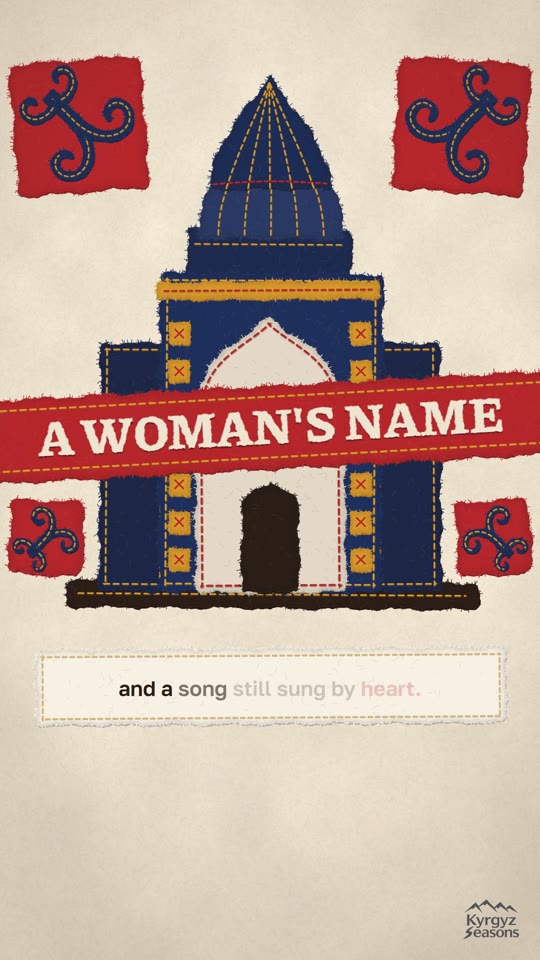
About twelve kilometres east of Talas stands a small square tomb of baked brick, with a ribbed, tent-shaped roof.
People call it the Gumbez of Manas, the tomb of the hero of the Kyrgyz epic. It is a portal-and-dome building of the 14th century, decorated with carved terracotta. The pointed tent over the dome looks ancient, but it is a restoration, made in 1969–70.
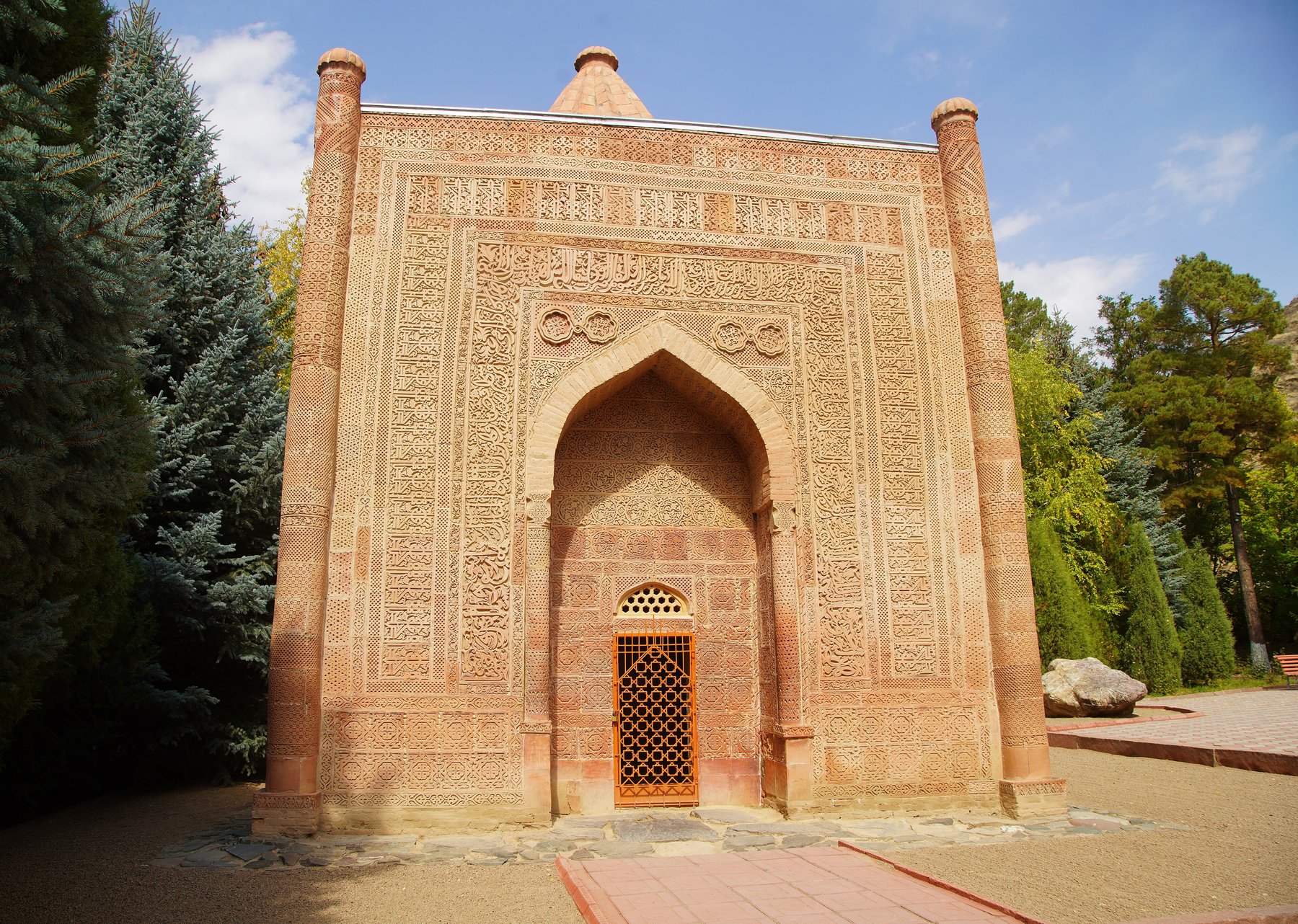
Now the twist. The Great Soviet Encyclopedia says the building was raised as the tomb of Kenizek-Khatun, daughter of the emir Abuka, and that only “by legend” is it counted as the grave of Manas. Two names, one door.
Half a million lines
“The hero is Manas. His epic runs half a million lines.”From the film
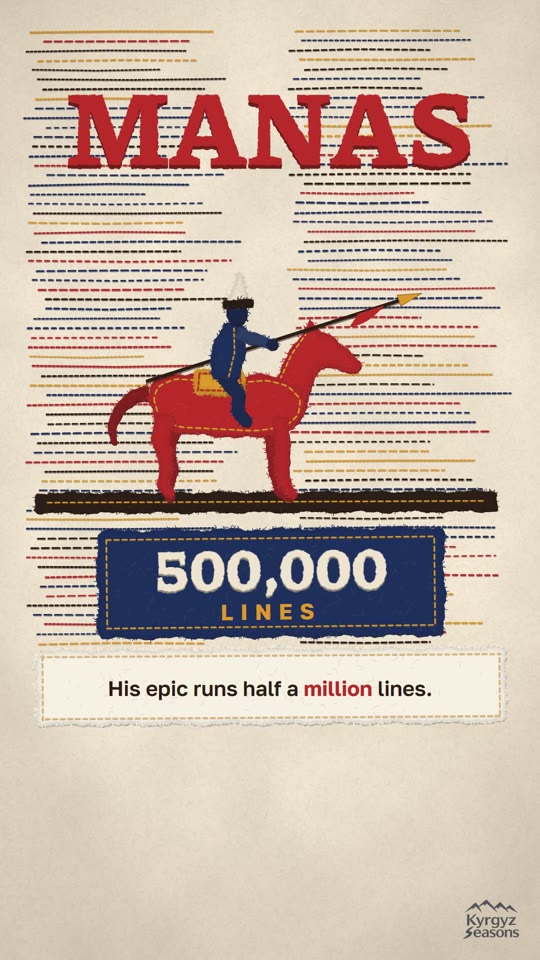
Manas is the hero of the great Kyrgyz epic, and the epic is the reason the tomb has a hero’s name at all.
It is a trilogy: the tale of Manas, then of his son Semetey and his grandson Seytek. For centuries nobody wrote it down. When Sayakbay Karalaev’s version was finally recorded in the 1930s, it filled 500,553 lines.
How long is it?
One strip of felt per poem, drawn to scale.
That is about eighteen times the Iliad and the Odyssey put together, and roughly two and a half times the Mahabharata. The Manas part alone, 84,830 lines, is about three times Homer’s two poems.
The calling
“For centuries it lived only in memory. Singers say the calling comes in a dream.”From the film
The people who carry the epic are called manaschi, and nobody becomes one simply by choosing it.
UNESCO describes how narrators accept their calling after a prophetic dream, understood as a sign from the heroes of the epic. In the accounts gathered by the researcher R. Sultanova, Manas himself appears in the dream and threatens the singer with illness and misfortune if he refuses to sing. That is the tradition as the singers tell it: a belief, not something anyone can check.
It is also a marathon. A continuous narration of the trilogy may last up to thirteen hours. A Party document of 1935 quotes people who remembered performances of sixteen to eighteen days, a memory and not a measurement.
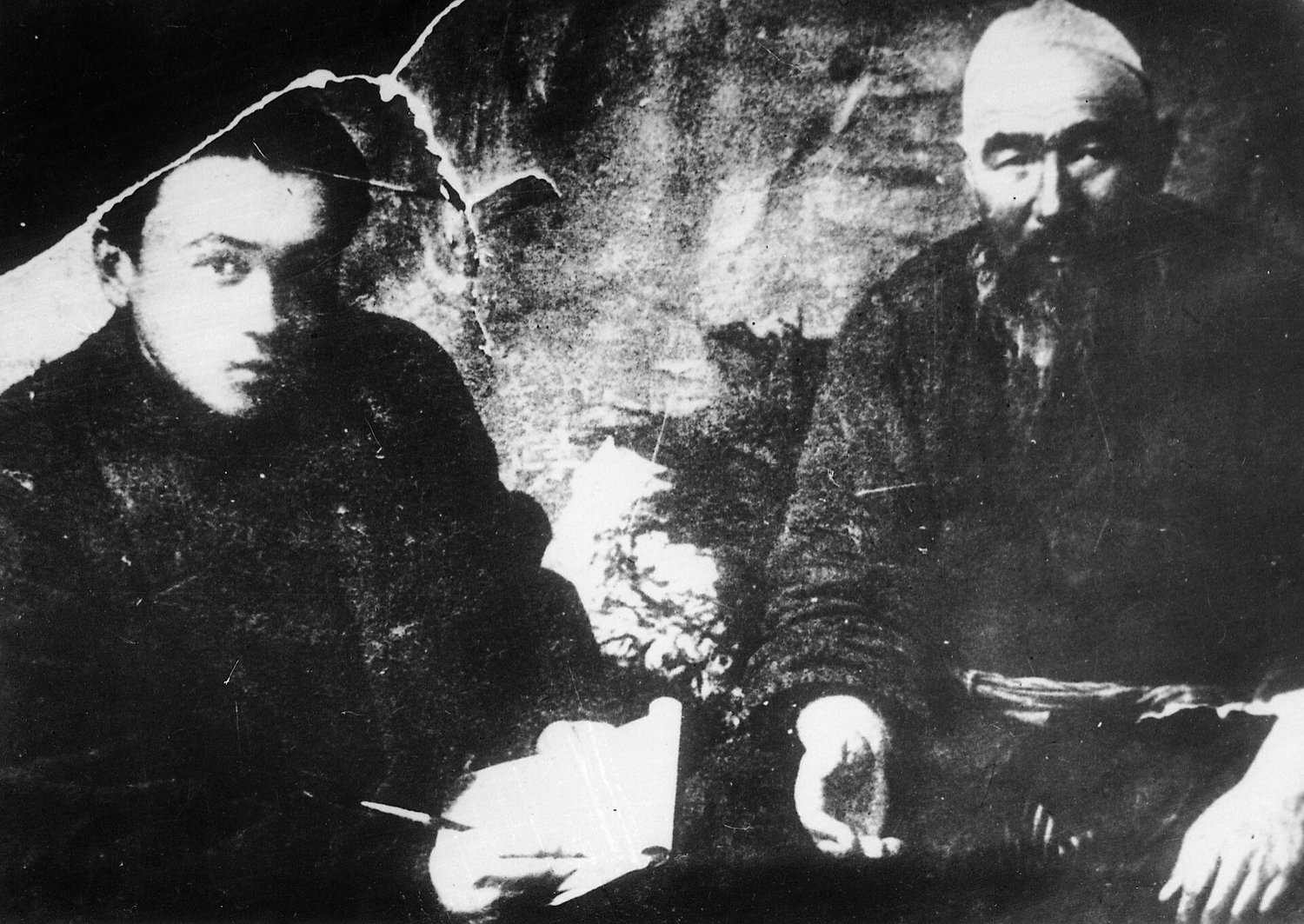
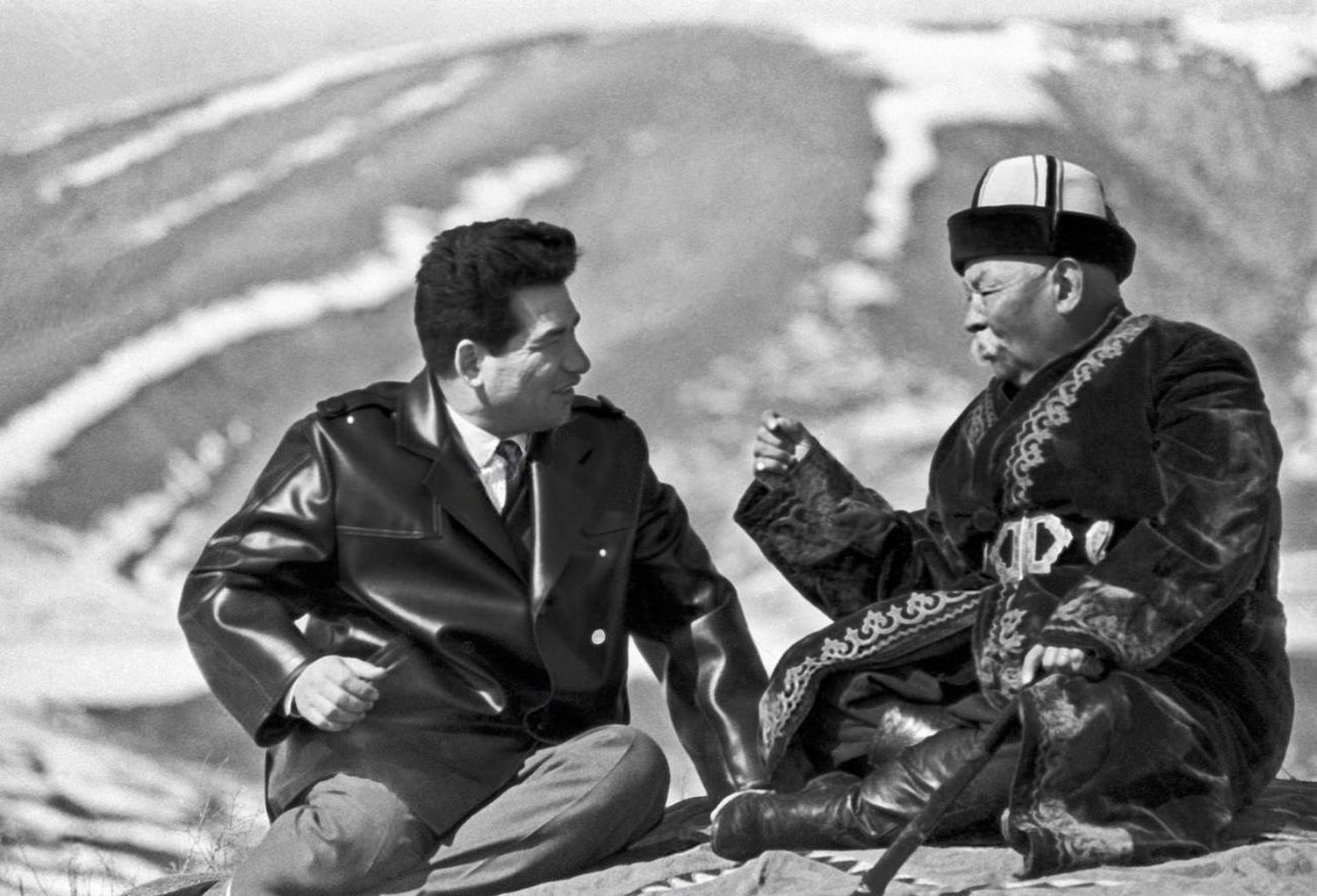
Writing the song down took a long time, and every step is dated:
- 1856First written downThe Kazakh scholar Chokan Valikhanov records a fragment and calls the epic the “Iliad of the Steppes”.
- 1862–69Radlov travelsThe scholar Vasily Radlov records episodes on his journeys; in 1885 he publishes 12,454 lines.
- 1922–26OrozbakovThe singer’s version is written down in ten handwritten books.
- 1935–37Karalaev84,830 lines of Manas are recorded; with Semetey, Seytek and the continuation, 500,553.
- 1995A “millennium”The UN General Assembly marks the year as the epic’s millennium, a symbolic date: scholars have not agreed on when it arose.
- 2013UNESCOThe Kyrgyz epic trilogy joins the Representative List of the Intangible Cultural Heritage of Humanity.
- 2023Memory of the WorldOrozbakov’s manuscript joins UNESCO’s Memory of the World register.
The inscription
“But its entrance names a woman: Kenizek-Khatun, an emir’s daughter.”From the film
Over the entrance, the portal carries an inscription in Kufic, an angular style of Arabic script, laid out in carved terracotta tiles.
A. M. Belenitsky proposed a reading in 1938, published in 1948, and M. E. Masson later corrected it. In the wording of the Manas Encyclopedia (translated from Kyrgyz), the text names a great mausoleum for the most glorious of women, Kenizek-Khatun, daughter of the emir Abuka.
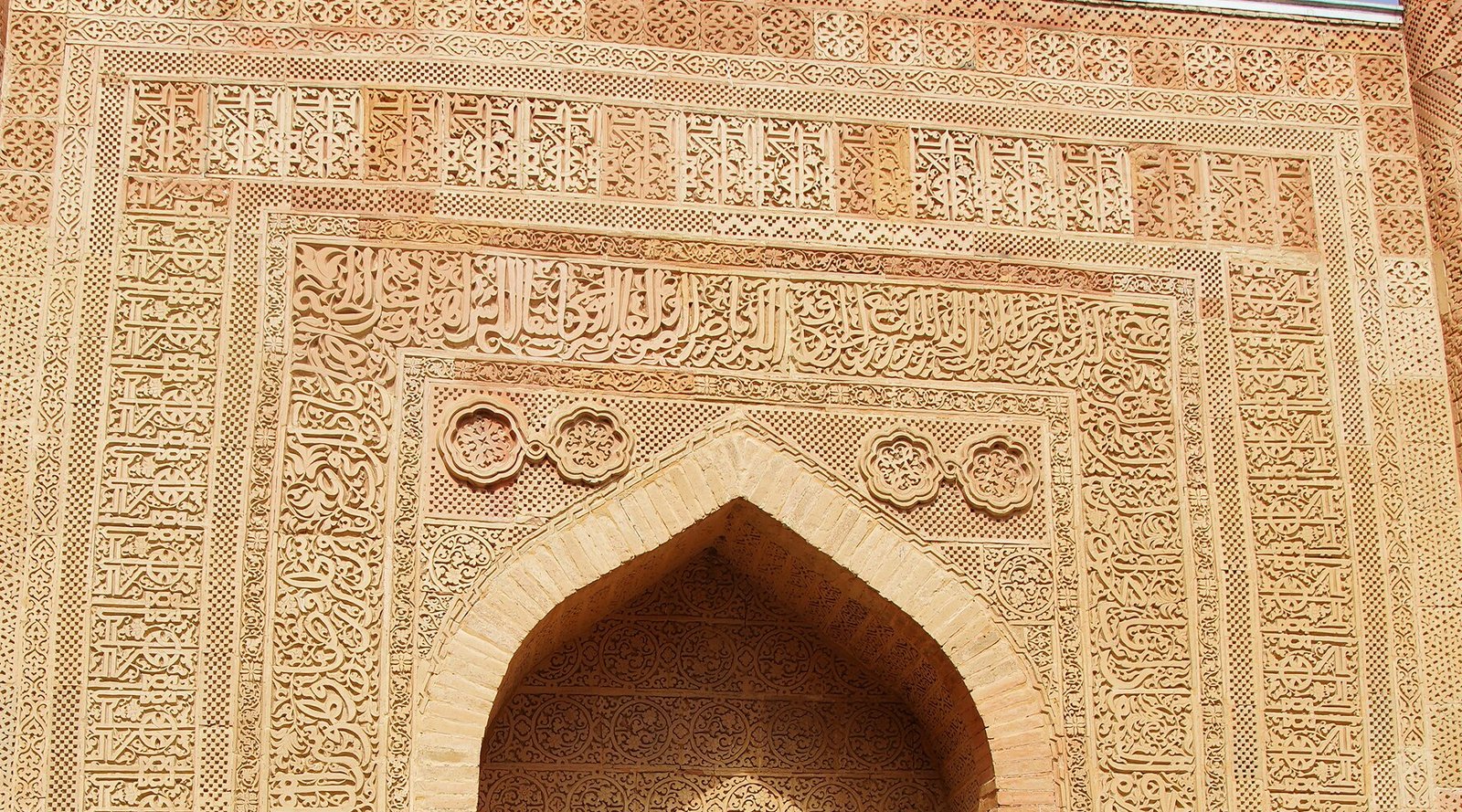
The end of the inscription is broken. The encyclopedia says the month of Ramadan and “the fourth year” can still be read, but not the decade, so the stone alone cannot give the year. Historians reconstructed it from other evidence: Kenizek-Khatun is thought to have died on Friday, 6 May 1334. That is why scholars date the tomb to 1334. It is a reconstruction, not a line you can read on the wall.
Fact, reconstruction or legend?
Six claims people make about the gumbez. Tap a patch to turn it over.
- FactThe Great Soviet Encyclopedia dates it to the 14th century.
- FactRead by Belenitsky in 1938 and corrected by Masson; the Manas Encyclopedia gives the reading.
- ReconstructionThe broken inscription gives no decade. Historians fixed 1334 from other evidence.
- Not soThe ribbed tent was restored in 1969–70.
- LegendA tradition of the epic and of the people, not a documented event.
- Not knownWe found no reliable source on what is inside. Russian Wikipedia notes there is no confirmation that it is the grave of Manas.
The wrong name
“Legend says his wife Kanykei had the wrong name carved, to keep enemies from his grave.”From the film
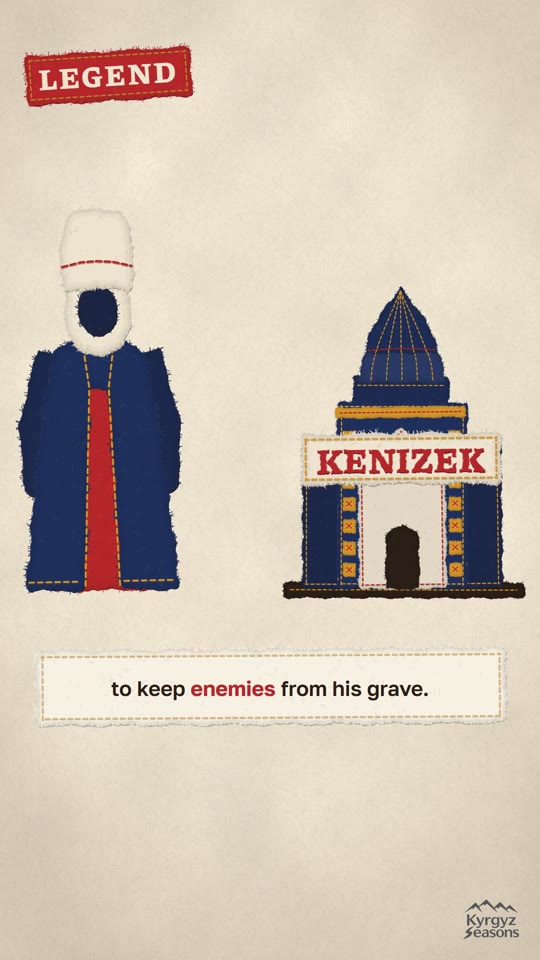
So how did a woman’s tomb become the hero’s? The people have an answer. It is a legend, not evidence.
Kanykei is the wife of Manas in the epic. The story is told in more than one way, so pick a version:
The epic also describes a grand dome over the hero’s grave, but that is poetry, a picture painted in words, not a description of this building.
The encyclopedia offers a quieter explanation for the name. This is the one well-preserved building of its kind in the region, and people tied it to the hero they loved best. The scholars’ conclusion: the name grew out of tradition, not out of historical data. In that sense the legend is not a mistake to be corrected. It is how a community remembered what it loved.
Sung by heart
“A hero’s tomb, a woman’s name, and a song still sung by heart.”From the film
The song did not stay in the notebooks of the 1930s.
Every 4 December Kyrgyzstan marks Manas Epic Day. In 2020 singers from across the country recited the epic at Manas Ordo without a break, from eleven in the morning on 4 December to eleven the next morning.
Whoever lies behind the Kufic door, the two names have settled into a pair. The woman’s name is carved in clay. The hero’s name lives in voices.
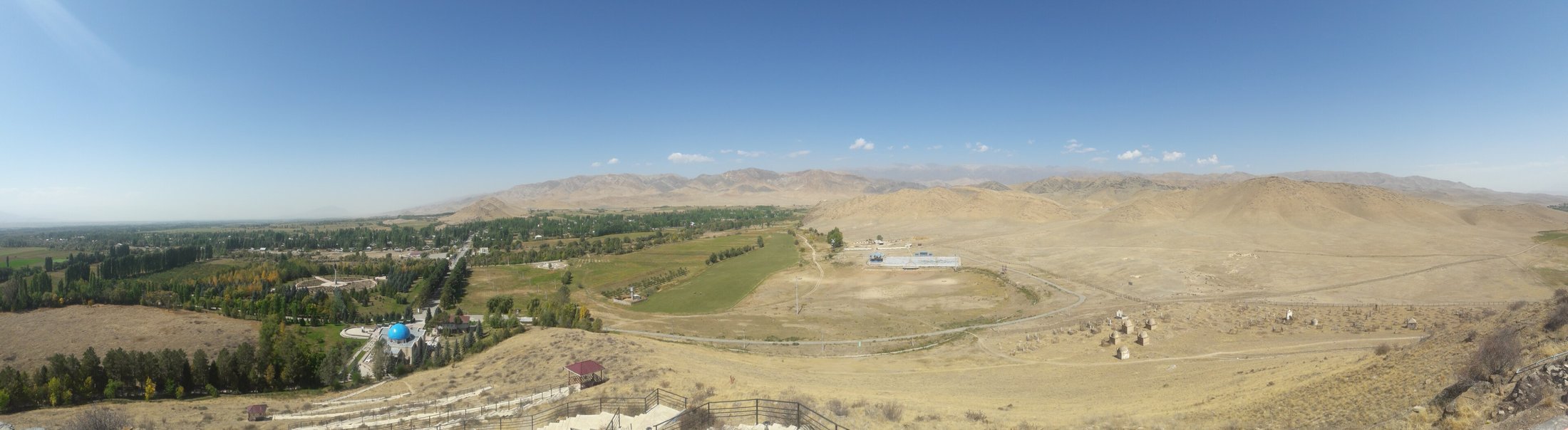
Stand before it
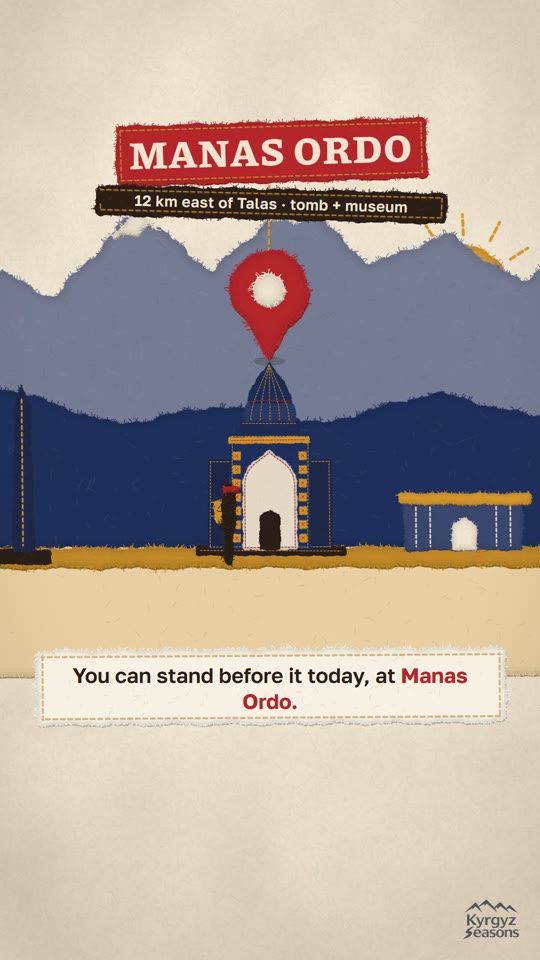
“You can stand before it today, at Manas Ordo.”From the film
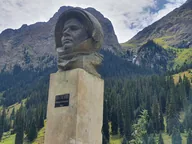
Manas Ordo is a memorial complex built around the gumbez. Besides the tomb there is a museum of the epic, with dioramas and portraits of singers, and a park with a stele where Manas stands, ringed by stone figures that are thought to represent his followers and warriors. The complex was built in 1995, the year of the epic’s “millennium”; after a reconstruction that began in 2024 it was reopened on 11 September 2026.
A hero’s tomb, a woman’s name
— and a song still sung by heart.
 Watch the 49-second filmThe same story as a felt carpet that sews itself: pieces fall, seams appear, and red and indigo trade places.
Want to see it for yourself?
Routes, places and the best months to go — everything for planning a trip to Kyrgyzstan.
Sources
- Great Soviet Encyclopedia, “Manas Mausoleum”. booksite.ru; “Manas” (the epic). booksite.ru
- Manas Encyclopedia, “Manastyn kumbozu”. el-sozduk.kg
- A. M. Belenitsky, on the Muslim epigraphy of the Talas Valley, Epigraphy of the East, II (1948). publication record
- R. Sultanova on Sayakbay Karalaev’s version (Toyo Bunko). toyo-bunko.repo.nii.ac.jp
- UNESCO, “Kyrgyz epic trilogy: Manas, Semetey, Seytek” (2013). ich.unesco.org
- UNESCO Memory of the World, the manuscript of the epic by Sagymbay Orozbakov (2023). unesco.org
- UN General Assembly resolution 49/129 (1994). hrlibrary.umn.edu
- Line counts: Iliad, Odyssey, Mahabharata, Epic of King Gesar (Wikipedia); Guinness World Records, longest poem ever published.
- Manas Ordo: Lonely Planet; Russian Wikipedia; Economist.kg and Time.kg (2026); 24.kg (2020); Kyrgyz Seasons, Manas Ordo.
Pictures
- Film stills: frames from the Kyrgyz Seasons film “The Hero’s Tomb With a Woman’s Name”.
- The gumbez of Manas Ordo, 20 September 2024: Mheidegger, CC BY 4.0, via Wikimedia Commons. The portal is a detail of the same photo.
- Manas Ordo, 11 September 2018: Ceever, CC BY-SA 4.0, via Wikimedia Commons.
- Sagymbay Orozbakov and Ybrai Toichinov, 1925: Kyrgyz state film, photo and audio archive (No. 0-56176), author unknown, public domain in Kyrgyzstan, via Wikimedia Commons.
- Sayakbay Karalaev and Chingiz Aitmatov, 1968: photographer unknown, first published in the USSR in 1968 and reprinted in the encyclopedia “Kirgizskaya SSR” (1982); Wikimedia Commons, CC BY-SA 4.0.