

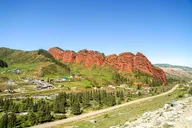
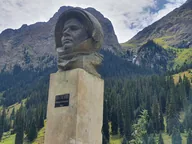
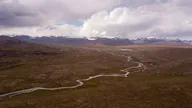

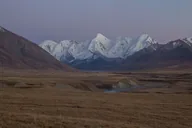


One Word on a Grave
In 1338 a stonecutter near today's Bishkek carved the cause of death on a gravestone. Almost 700 years later, the same graves told scientists where the Black Death most likely began.
Watch the film · 80 sThe word
“In 1338, in a valley in Kyrgyzstan, a stonecutter carved one word on a grave: pestilence.”From the film
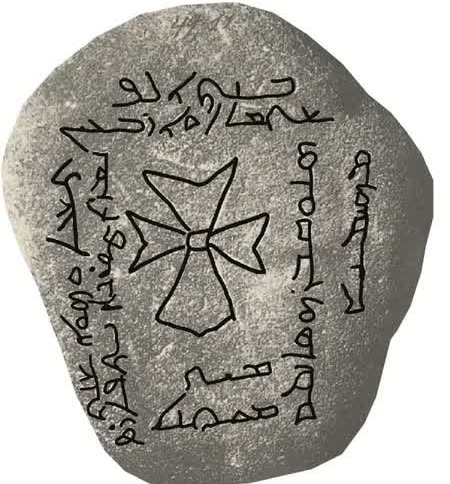
Near today's Bishkek, a Christian town buried its dead under rounded river stones. Each stone got a cross and a few lines of script.
In 1338 a stonecutter added something new: the reason. One word — mawtānā, “pestilence”. It names no disease. Nobody in the 14th century knew what plague was. It just means a death that comes for many people at once.
Read it yourself
Syriac runs right to left and mostly skips the vowels — the reader adds them. Tap the letters.
Then another. And another.
“Then on another grave. And another. For two years, the dead kept coming.”From the film
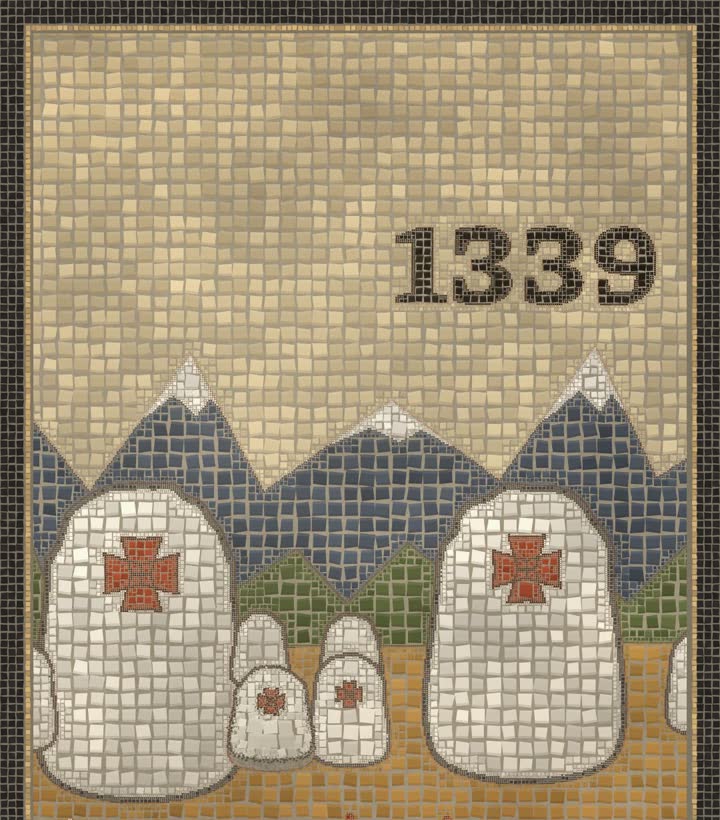
Two cemeteries of the same community survived: one at Kara-Djigach, the other further east, by Burana Tower near Tokmok. When archaeologists dug them up, they recorded 456 gravestones at the first and 11 at the second.
The dated stones are spread over many decades. Then comes a spike: an unusually large share of the dead were buried in just two years, 1338 and 1339 — and several stones from those years give the same cause of death.
Who were they?
“They were Silk Road Christians who spoke Turkic and wrote in Syriac letters.”From the film
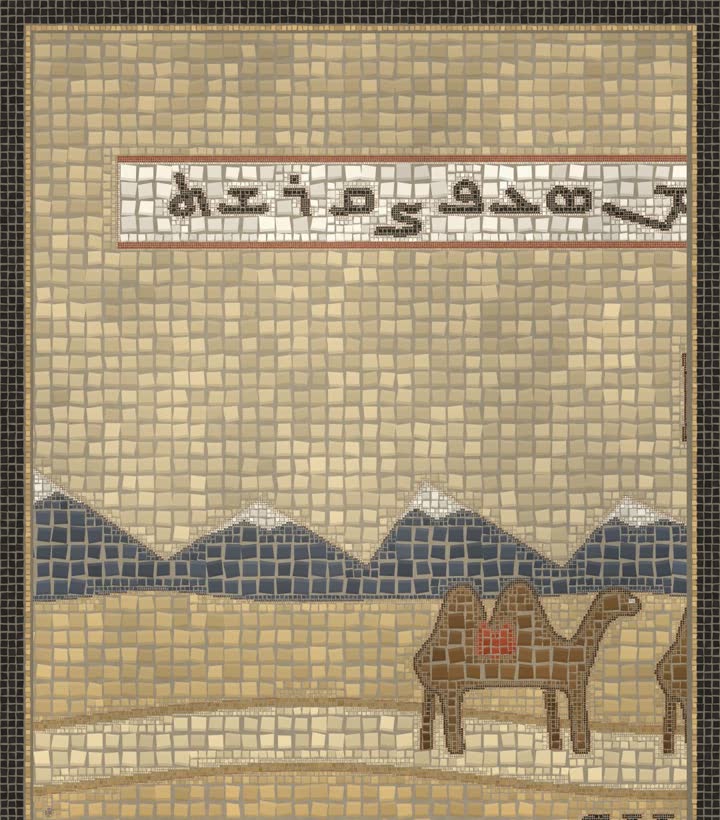
They belonged to the Church of the East — the easternmost church of the Middle Ages, with communities strung along the Silk Road from Mesopotamia to China. Their liturgy was in Syriac, a dialect of Aramaic. Their everyday language was Turkic.
So they did something unusual: they wrote Turkic words in Syriac letters. Many of the Chüy Valley stones mix the two languages on a single line.
Two cemeteries, one community
The Chüy Valley today. Schematic, not to scale.
Sanmaq, the believer
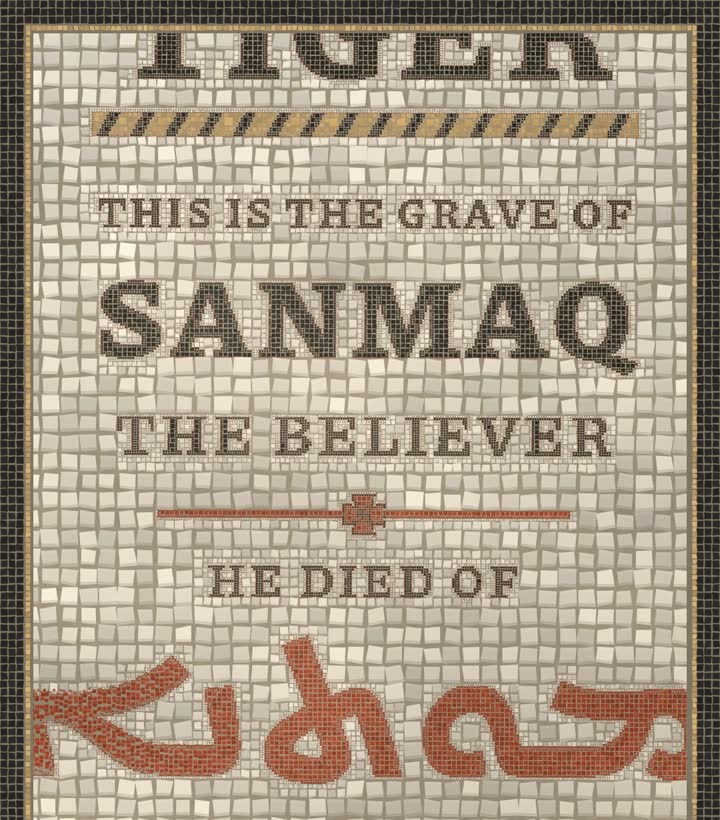
“One stone reads: Year of the Tiger. This is the grave of Sanmaq, the believer. He died of pestilence.”From the film
Most gravestones say little: a cross, a date, a name. One of them, from Kara-Djigach, became the most quoted inscription of the whole story.
Two calendars sit in one line. The year 1649 is counted in the Seleucid era, “the years of the Greeks”, the calendar Syriac Christians used for centuries. The Tiger comes from the 12-year animal cycle of the steppe.
Decode the date
Pick a year from the gravestones.
Eight years later
“Eight years later, plague hit the Black Sea. Then Europe. The Black Death killed up to half its people.”From the film
- 1338–1339Chüy Valley“Pestilence” on the gravestones of Kara-Djigach.
- 1346Black SeaPlague breaks out in the lands of the Golden Horde on the Black Sea coast. This is where historians usually start the Black Death.
- 1347Messina, SicilyShips carry it into the Mediterranean.
- 1348Western EuropeFlorence, Paris, London.
- 1353Europe counts its deadIn seven years, the deadliest pandemic in recorded history.
Up to half
Historians' estimates for Europe range from about 30% to 60% of the population. Drag to compare.
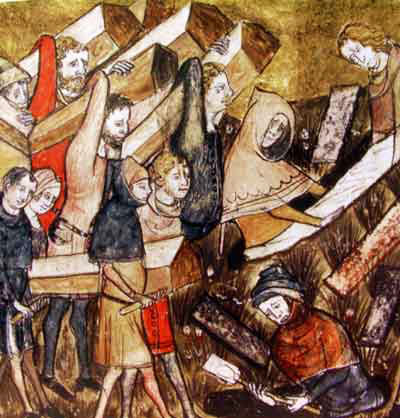
Did it start here?
“Five centuries on, diggers found these graves, and scholars asked: did it start here?”From the film
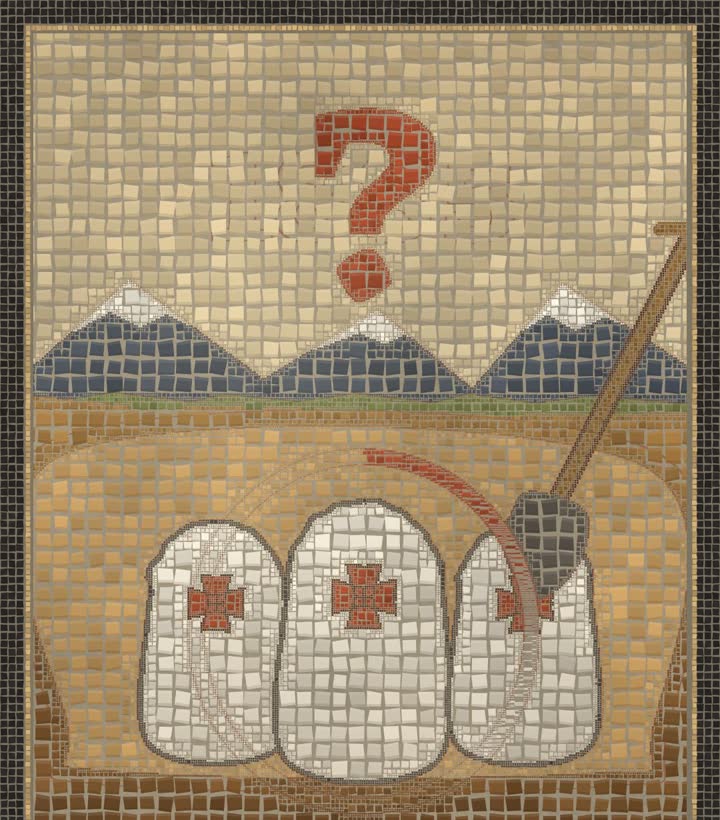
In 1885 the local scholar Nikolai Pantusov mapped the cemetery at Kara-Djigach. Digging went on until 1892. In St Petersburg the orientalist Daniel Chwolson read the inscriptions and published them.
A spike of deaths. The word “pestilence”. And a date just eight years before the Black Death reached Europe. The question was obvious — but with nothing but stones, nobody could answer it. For 130 years, it stayed open.
It was plague
“In 2022, scientists pulled DNA from teeth in those graves. It was plague.”From the film

In 2022 a team of geneticists and historians went back to the skeletons in St Petersburg. They took samples from the teeth of seven people: five from Kara-Djigach, two from Burana. Teeth are a good place to look — their pulp was full of blood, and blood carries what killed you.
Three of the five from Kara-Djigach carried DNA of Yersinia pestis, the plague bacterium.
Seven people, three answers
Tap a stone.
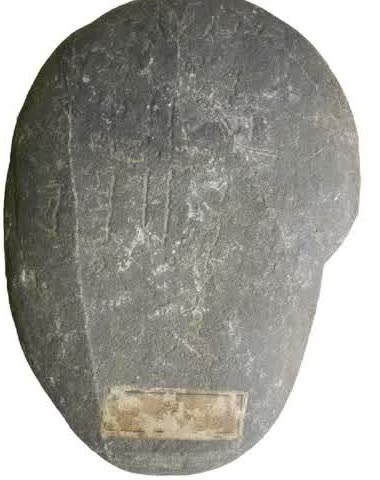
Not just any plague
“Not just any strain — the ancestor of the ones that swept Europe. Its living cousins still hide in the marmots of the Tian Shan.”From the film
Two genomes were good enough to place on the plague family tree. They landed on its most famous fork — the “Big Bang”, where plague burst into four branches. One of those branches carried the Black Death into Europe. The Kara-Djigach strain sits right at the fork, as the ancestor of all four.
Where Kara-Djigach sits
A simplified plague family tree. Time runs upwards.
And the closest living relatives? Their strains come from one region only: eastern Kyrgyzstan, eastern Kazakhstan and Xinjiang — the Tian Shan. Most were found in marmots and their parasites.

Stand where they stood
“The town is gone, but its second cemetery lay by Burana Tower — an easy day trip from Bishkek.”From the film
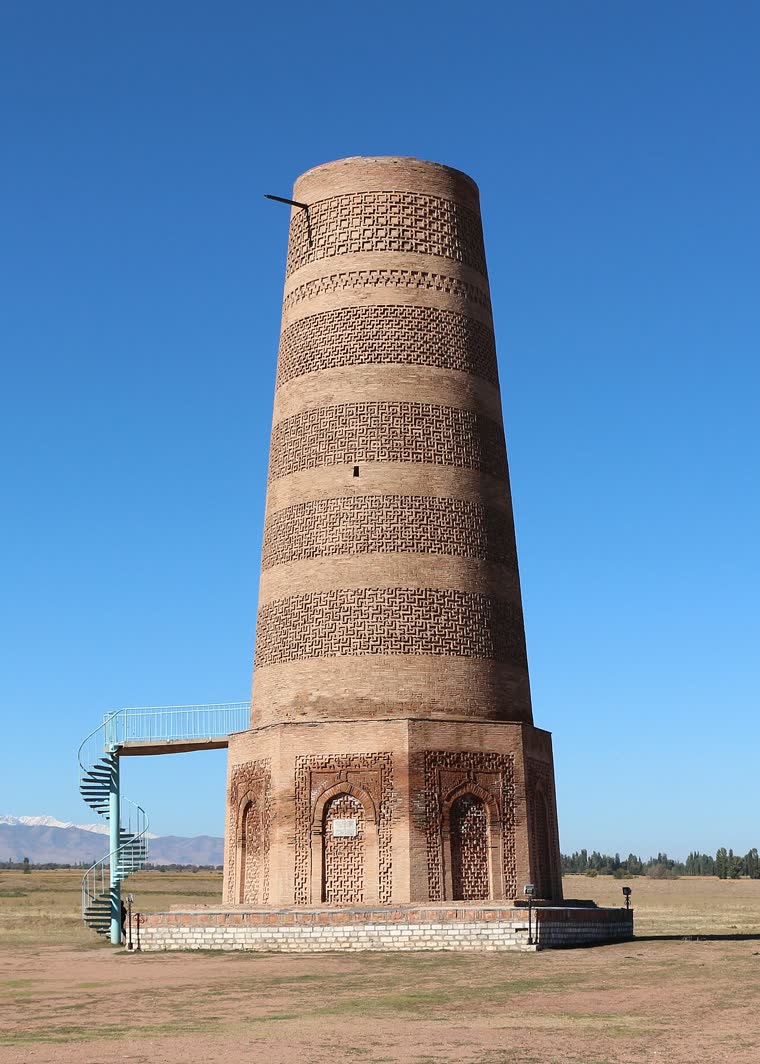
Nothing is left of Kara-Djigach to visit. But the same community buried its dead at Burana too — beside a brick minaret that has stood on the plain since the 11th century. The tower, the grassy ruins of the old town and the stone field are one easy day out of Bishkek.
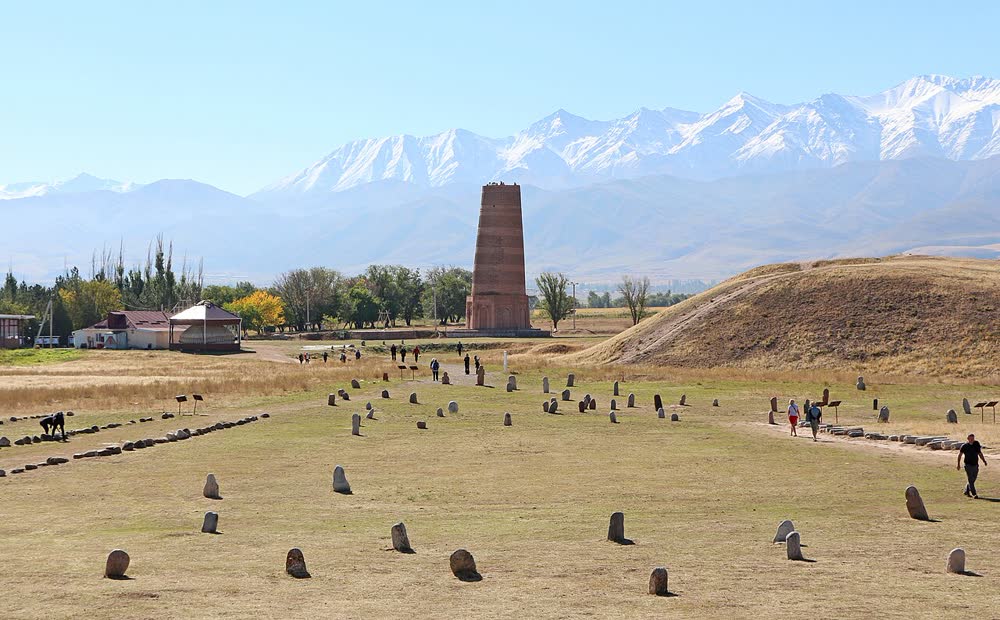
One word on a stone
— and, most likely, the birthplace of history’s deadliest pandemic.
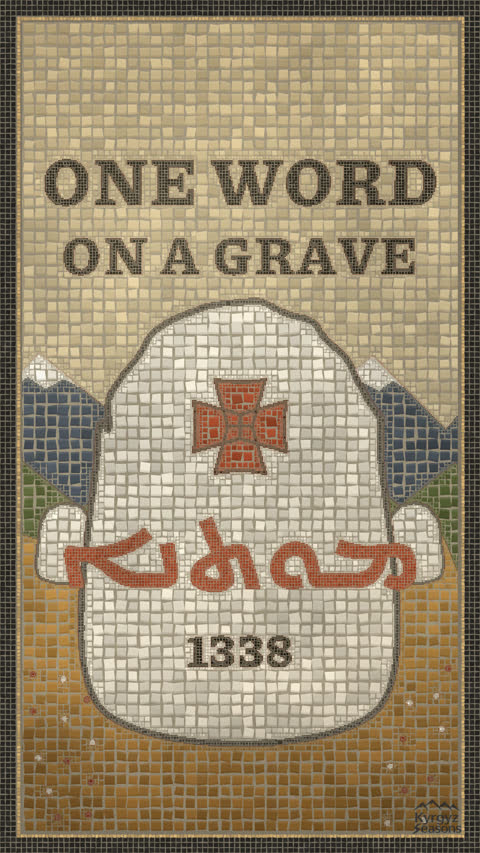 Watch the 80-second filmThe same story as a stone mosaic that builds itself, tile by tile.
Want to see it for yourself?
Routes, places and the best months to go — everything for planning a trip to Kyrgyzstan.
Sources
- M. A. Spyrou et al., “The source of the Black Death in fourteenth-century central Eurasia”, Nature 606, 718–724 (2022). doi.org/10.1038/s41586-022-04800-3
- D. Chwolson, Syrisch-nestorianische Grabinschriften aus Semirjetschie, St Petersburg, 1886–1897.
- W. Klein, on the Turkic language of the Syriac gravestone inscriptions, Hugoye: Journal of Syriac Studies 5:2.
- O. J. Benedictow, The Black Death 1346–1353: The Complete History, Boydell, 2004. Benedictow puts Europe’s death toll at about 60%; other historians give lower figures, from about 30%.
- Kyrgyz Seasons, Burana Tower: tickets and visiting.
Pictures
- Mosaics: frames from the Kyrgyz Seasons film “One Word on a Grave”.
- Kara-Djigach gravestones: Spyrou et al., Nature 2022, Extended Data, CC BY 4.0, via Wikimedia Commons.
- Tournai miniature: Gilles Li Muisis chronicle, Royal Library of Belgium, public domain.
- Grey marmot: Egor Volarov, CC BY 4.0. Burana Tower and site: Bernard Gagnon, CC0. All via Wikimedia Commons.